Daily practice
How do I measure sobriety progress beyond day counts?
Measure sobriety progress by recording what recovery actually changes: your health, your sleep, your relationships, your sense of purpose, and your ability to cope. Researchers call this recovery capital, and it is measurable. A day count tells you how long. It does not tell you whether your life is getting better. The evidence you capture does.
A day count answers one question: how long. It cannot tell you whether your sleep improved, whether you rebuilt a relationship, or whether you are becoming someone who no longer needs the habit. Here is what the research says to measure instead, and how to record it without turning your recovery into a spreadsheet.
How do I measure sobriety progress beyond day counts?
Measure the domains that recovery is supposed to change. The most established framework for this is recovery capital, defined by William Cloud and Robert Granfield as the breadth and depth of internal and external resources a person can draw on to start and sustain recovery. In 2013, Teodora Groshkova, David Best, and William White published the Assessment of Recovery Capital (ARC) in Drug and Alcohol Review, a 50 item scale built from 10 domains of five items each. It takes 5 to 10 minutes to complete, and it measures strengths rather than symptoms.
That distinction matters. As the authors wrote, historical treatment outcome measures "have focused on the reductions in symptoms and pathologies," which tell you very little "about the personal and social assets that aided recovery." A day counter has the same blind spot. It records an absence.
What are the domains worth measuring?
These are the ten ARC domains, each scored 0 to 5, for a total out of 50. In the original study, a total score of 27.5 best separated people in stable recovery of five years or more from those earlier in the process, with 92 percent sensitivity and 69 percent specificity, and an area under the curve of 0.89.
| Domain | The question it really asks | What a Proof of it looks like |
|---|---|---|
| Substance use and sobriety | Am I steady with the thing I left behind? | A dated note on the day you got through it |
| Global psychological health | Is my mood more stable than it was? | A voice note on a hard morning |
| Global physical health | Do I feel better in my body? | A photo, six weeks apart |
| Social support | Is there someone I can call? | A note after the call |
| Meaningful activities | Am I doing something that matters to me? | A photo of the thing you made or finished |
| Housing and safety | Is my living situation stable? | A photo of the room you cleaned |
| Citizenship and community involvement | Am I part of something? | A note after showing up |
| Coping and life functioning | Can I handle a bad day without the old exit? | A journal entry from the bad day |
| Risk taking | Am I making safer choices? | A note on the choice you did not make |
| Recovery experience | Do I believe this is working? | Your own words, dated |
The ARC has real limits worth stating. It was validated on 142 people in Scottish treatment services and 176 people in English recovery communities, it relies on self-report with no biological verification, and its test to retest reliability was measured over a single week. It is a useful map, not a lab result.
What does the research say actually changes over time?
Well-being rises, but not in a straight line, and not immediately. In 2018, John F. Kelly, M. Claire Greene, and Brandon G. Bergman published "Beyond Abstinence" in Alcoholism: Clinical and Experimental Research, using a national, probability based sample of 2,002 U.S. adults who reported having resolved an alcohol or drug problem. They tested five measures: quality of life, happiness, self-esteem, recovery capital, and psychological distress.
The pattern was steep early gains, with the sharpest improvements in the first several years, then a shallower climb that continued across decades. With one exception. In the first year, self-esteem and happiness went down before they went up.
If you are three months in and you feel worse than you expected, that is documented, and it is not a sign you are doing it wrong. Note the caveat: this study compared different people at different points in recovery rather than following the same people over time, so it describes a pattern across a population, not a guaranteed personal timeline.
Why do federal definitions of recovery include more than drinking?
Because the agencies that define recovery say the drinking is only part of it. The National Institute on Alcohol Abuse and Alcoholism research definition, published by Brett T. Hagman, Daniel Falk, Raye Litten, and George F. Koob in American Journal of Psychiatry on April 12, 2022, has three components: remission from DSM-5 alcohol use disorder, cessation from heavy drinking, and biopsychosocial functioning and quality of life.
"Stakeholder feedback stressed the importance of incorporating well-being and biopsychosocial functioning constructs as integral to any definition of recovery."
Hagman, Falk, Litten, and Koob, NIAAA, American Journal of Psychiatry, 2022
To be clear about where Door 24 stands: that definition permits non-heavy drinking as an outcome, and we do not. We are abstinence leaning. What we take from it is the third component, which is that functioning and quality of life are part of the measurement, not a bonus.
SAMHSA's working definition of recovery makes the same point with four dimensions: health, home, purpose, and community. Nothing in either framework is captured by a number that resets.
How often should I record it?
Daily capture, monthly review. Those are two different jobs.
Daily capture should take under a minute, because anything longer gets abandoned in week three. One photo, one voice note, or two sentences. The reason to do it daily is that memory is unreliable in early recovery, and a month later you will underrate how hard week two actually was.
Monthly review is where you read backward. Health, sleep, mood, and relationships change too slowly to see day to day. They are obvious across eight weeks. This is also why relapse risk deserves a separate frame: NIDA puts relapse rates for substance use disorders at 40 to 60 percent, comparable to other chronic conditions, so a measurement system that survives a bad day is not optional.
How does Door 24 measure progress?
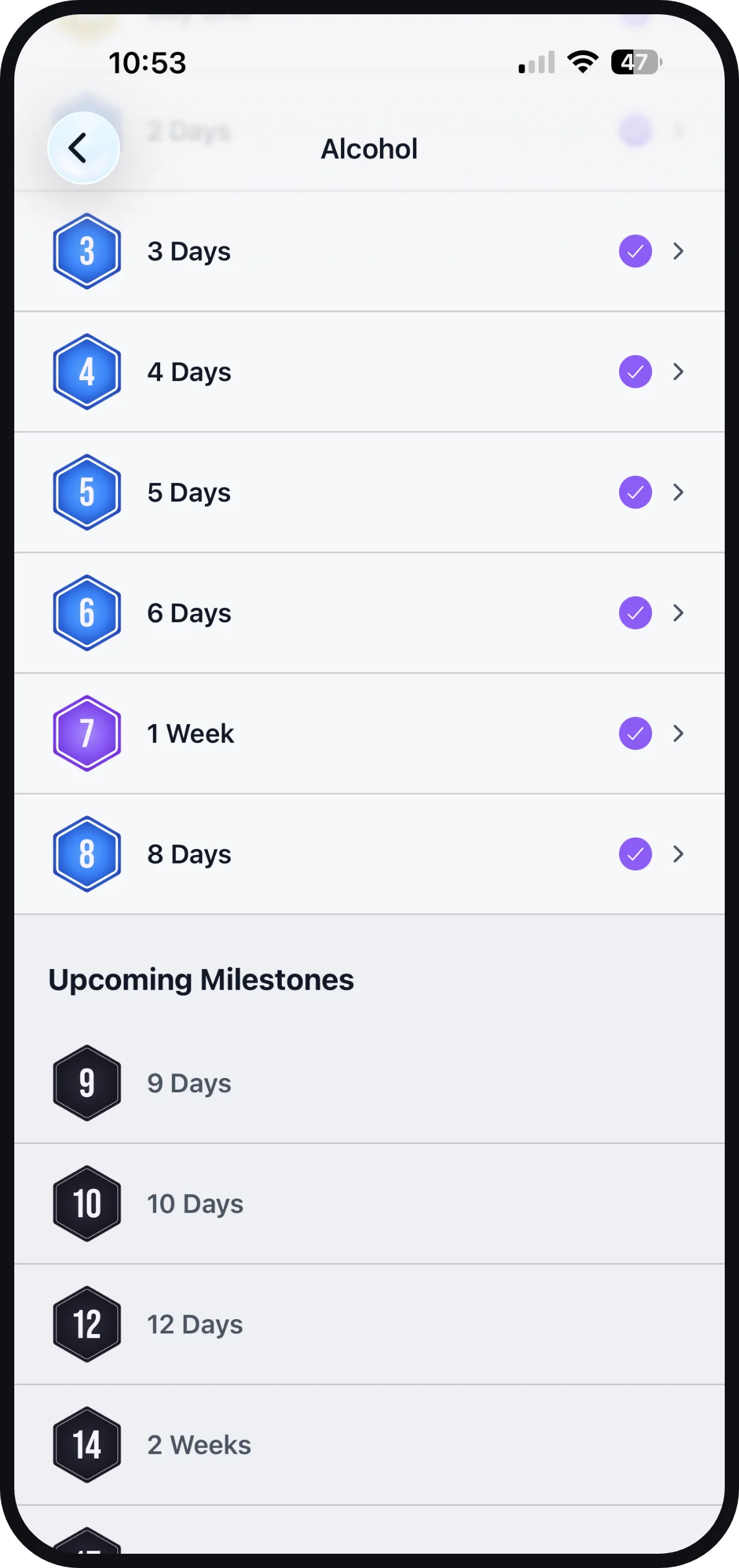
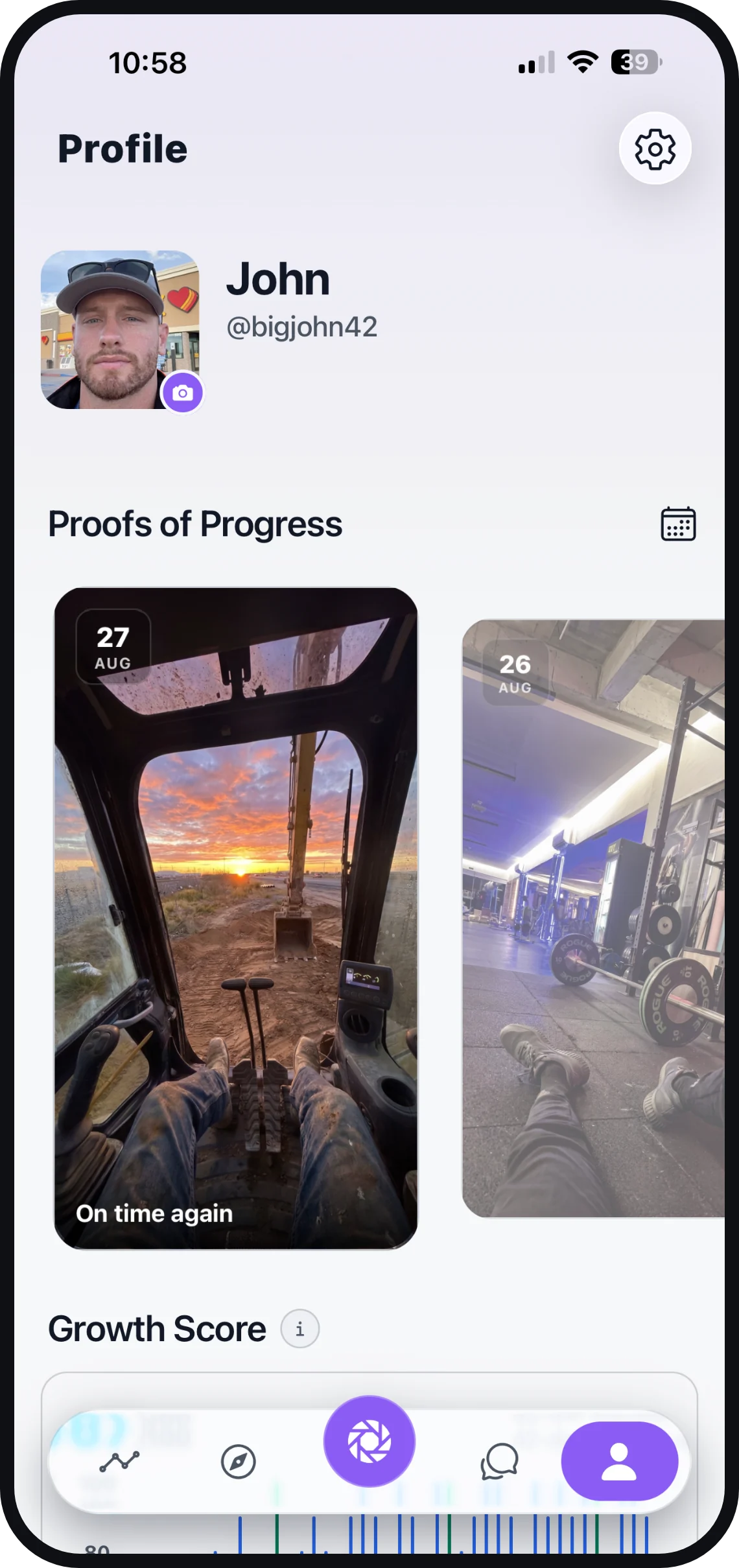
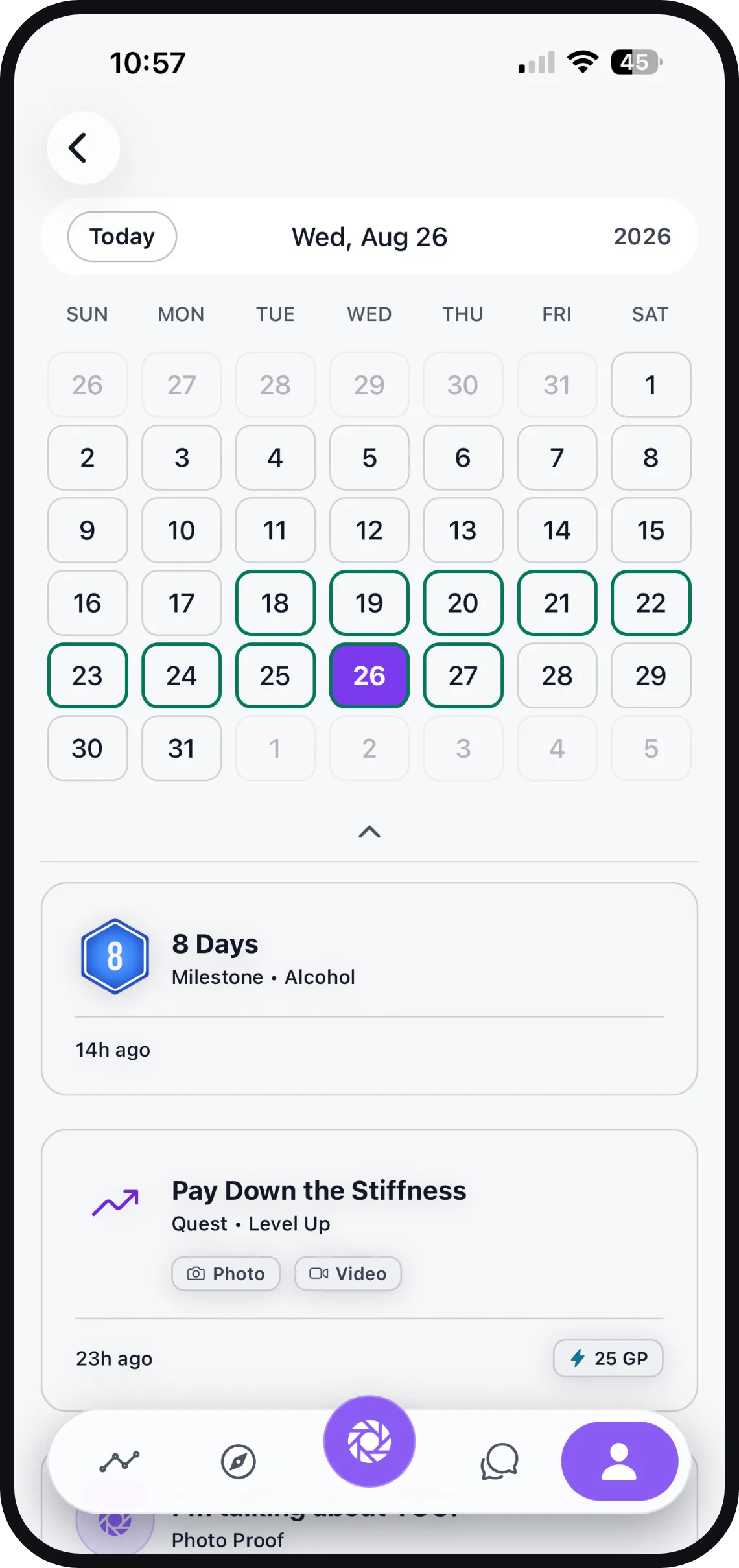
Door 24 was built for exactly this gap. Every sober day becomes a Proof, a dated photo, video, voice note, or journal entry that lands on your timeline. That is the daily capture, and it is the raw material of every domain in the table above. Scroll back three months and you are not looking at a number, you are looking at evidence.
Your Growth Score is a 42-day rolling average of consistency, not a streak. A hard day bends the line. It does not delete the record underneath it. The Freedom Ledger counts the money and time you have reclaimed, which is one of the few recovery-capital gains that is genuinely easy to quantify. And the Freedom Pledge keeps your own reason in your own words, dated, so you can measure yourself against it.
Abstinence is not enough. The point is not to count the days. It is to make them count, and then to be able to prove it.
Related reading: why sobriety streaks backfire, why abstinence alone is not enough, and how to find yourself again after addiction. If you want the money and time side of it, see the Freedom Ledger, or get the app.
Sources
- Groshkova, T., Best, D., & White, W. (2013). The Assessment of Recovery Capital: Properties and psychometrics of a measure of addiction recovery strengths. Drug and Alcohol Review, 32(2), 187-194.
- Kelly, J. F., Greene, M. C., & Bergman, B. G. (2018). Beyond Abstinence: Changes in Indices of Quality of Life with Time in Recovery in a Nationally Representative Sample of U.S. Adults. Alcoholism: Clinical and Experimental Research, 42(4), 770-780.
- Hagman, B. T., Falk, D., Litten, R., & Koob, G. F. (2022). Defining Recovery From Alcohol Use Disorder: Development of an NIAAA Research Definition. American Journal of Psychiatry, 179(11), 807-813.
- Substance Abuse and Mental Health Services Administration. SAMHSA's Working Definition of Recovery.
- National Institute on Drug Abuse. Treatment and Recovery.
Frequently asked
What should I measure in sobriety besides days sober?
Measure the things recovery is supposed to improve: physical health, psychological health, sleep, social support, housing and safety, meaningful activity, community involvement, coping, and risk taking. Those ten areas are the domains of the Assessment of Recovery Capital, a validated 50 item scale published in Drug and Alcohol Review in 2013.
What is recovery capital?
Recovery capital is the breadth and depth of internal and external resources a person can draw on to start and sustain recovery, a definition from Cloud and Granfield. It covers health, relationships, housing, purpose, and coping skills. Unlike a symptom checklist, it measures strengths rather than damage.
Why does progress feel worse in the first year of sobriety?
It is common. In a nationally representative study of 2,002 U.S. adults who had resolved an alcohol or drug problem, published in Alcoholism: Clinical and Experimental Research in 2018, most well-being measures improved with time in recovery, but self-esteem and happiness dipped during the first year before rising. Feeling flat early on is not evidence that it is not working.
How often should I record sobriety progress?
Capture something small daily so the record is complete, then review it monthly. Daily capture takes under a minute and protects you from hindsight bias. Monthly review is where the trend becomes visible, because week to week change in health, mood, and relationships is usually too small to notice.
Is counting sober days bad?
No. A date is a useful anchor and many people find the count motivating. The problem is making the count the only measure, because it says nothing about whether your life improved, and it resets to zero after a hard day. Keep the date. Add evidence.