Daily practice
What should a morning routine in early recovery look like?
A morning routine in early recovery should be short, fixed, and captured. Three or four actions in the same order, in under thirty minutes, done before the day can make demands of you. Sleep is badly disrupted in early sobriety, so mornings are the hardest hour and the most controllable one. The point is not productivity. It is one repeatable win, on the record, before 9am.
Most morning routine advice was written for people who slept well. In early recovery you probably did not. Here is a version built for the mornings you actually have.
What should a morning routine in early recovery look like?
A morning routine in early recovery should be short, fixed, and captured. Three or four actions, in the same order, every day, finished in under thirty minutes. Short so it survives a bad night. Fixed so it stops being a decision. Captured so the day leaves evidence behind instead of vanishing.
That last part is the one most people skip, and it is the one that compounds. A morning you completed and forgot is worth almost nothing by Friday. A morning you recorded is still there in October.
Scale matters here too. NIAAA reports that 27.9 million Americans ages 12 and older, or 9.7 percent, had alcohol use disorder in 2024. Most of them are not in a program. They are just trying to get through a Tuesday morning.
Why are mornings so hard in early sobriety?
Because your sleep is still broken, and it does not repair on schedule. In their review of alcohol and sleep in Current Opinion in Psychology, Sean He, Brant Hasler, and Subhajit Chakravorty report that insomnia prevalence in people with alcohol use disorder ranges from 36 to 91 percent, against roughly 10 percent in the general population, and that it shows up at every stage: active drinking, withdrawal, and recovery.
They are direct about what that means for staying sober. "The prevalence of insomnia decreases when these individuals transition from active drinking to abstinence," they write, "with persistent insomnia being a risk factor for relapse for them."
The pattern is old news to researchers. In a 2001 study of 172 people in treatment for alcohol dependence, published in the American Journal of Psychiatry, Kirk Brower and colleagues found that over 60 percent had symptomatic insomnia in the six months before treatment, and those with insomnia were far more likely to have been drinking to fall asleep (55 percent versus 28 percent). Take the drink away and the sleep problem is still sitting there.
There is a body clock component as well. The same review notes that alcohol disrupts circadian timing, and cites work by Conroy and colleagues finding an 18 minute delay in dim light melatonin onset in alcohol dependent adults compared with healthy controls. Your internal morning is running late. A fixed wake time and early daylight are how you argue with that.
What should you actually do in the first thirty minutes?
Keep it to four moves. The specifics are less important than the order staying the same.
| Minutes | Action | Why it earns the slot |
|---|---|---|
| 0 to 2 | Get up at a fixed time. Water first. | A stable wake time is the strongest lever you have on a delayed body clock. |
| 2 to 7 | Get outside or to a window. Daylight on your face. | Morning light is the main signal that resets circadian timing, which alcohol has been pushing later. |
| 7 to 20 | Move. A walk counts. | Movement is the cheapest thing you can do about the flat, irritable mood of a bad night. |
| 20 to 30 | Check in and capture it. One photo, one voice note, or five written lines. | Turns a completed morning into something you can look at again in ninety days. |
Notice what is not on the list. No cold plunge, no journaling marathon, no 5am. A routine you can only do when you feel good is not a routine, it is a mood.
Write the plan as an if-then sentence rather than an intention. "When my alarm goes off, I put my feet on the floor and drink the water I set out last night." In their meta-analysis in Advances in Experimental Social Psychology, Peter Gollwitzer and Paschal Sheeran found that these implementation intentions produced a medium to large effect on goal attainment across 94 independent tests, d = 0.65. Deciding in advance where and when beats deciding again every morning.
How long until a sober morning routine feels automatic?
Longer than the number you have been told. Phillippa Lally and colleagues at University College London followed 96 people who chose one daily behavior and repeated it in the same context for 12 weeks, published in the European Journal of Social Psychology in 2010. The median time to reach 95 percent of maximum automaticity was 66 days. The individual range was 18 to 254 days.
Two things follow from that. Twenty one days is a myth. And the variation is enormous, so comparing your day 30 to someone else's day 30 tells you nothing useful.
The reassuring finding is what happened when people missed a day. A single missed opportunity did not meaningfully damage the habit forming process. Consistency across weeks was what predicted automaticity, not a perfect record.
What happens when you have a bad morning?
You have the next one. This is where most recovery tools quietly work against you.
NIDA puts relapse rates for substance use disorders at 40 to 60 percent, which the agency notes is similar to, and in fact lower than, the 50 to 70 percent seen in chronic conditions like hypertension and asthma. Setbacks are built into the terrain, not evidence of a character flaw. A tool that responds to one hard morning by deleting your history is measuring the wrong thing, and it is teaching you the wrong lesson about yourself.
The honest question is never "did you go perfect." It is "where is the line heading." Watch the trend. For the mechanics of why hard mornings turn into cravings, see why you crave alcohol when you are stressed. For how the rest of the day fits around this, see what a daily sobriety routine looks like.
Why should you capture your morning instead of just counting it?
Because a count tells you how many. A capture tells you who. Those are different questions, and only one of them changes anything.
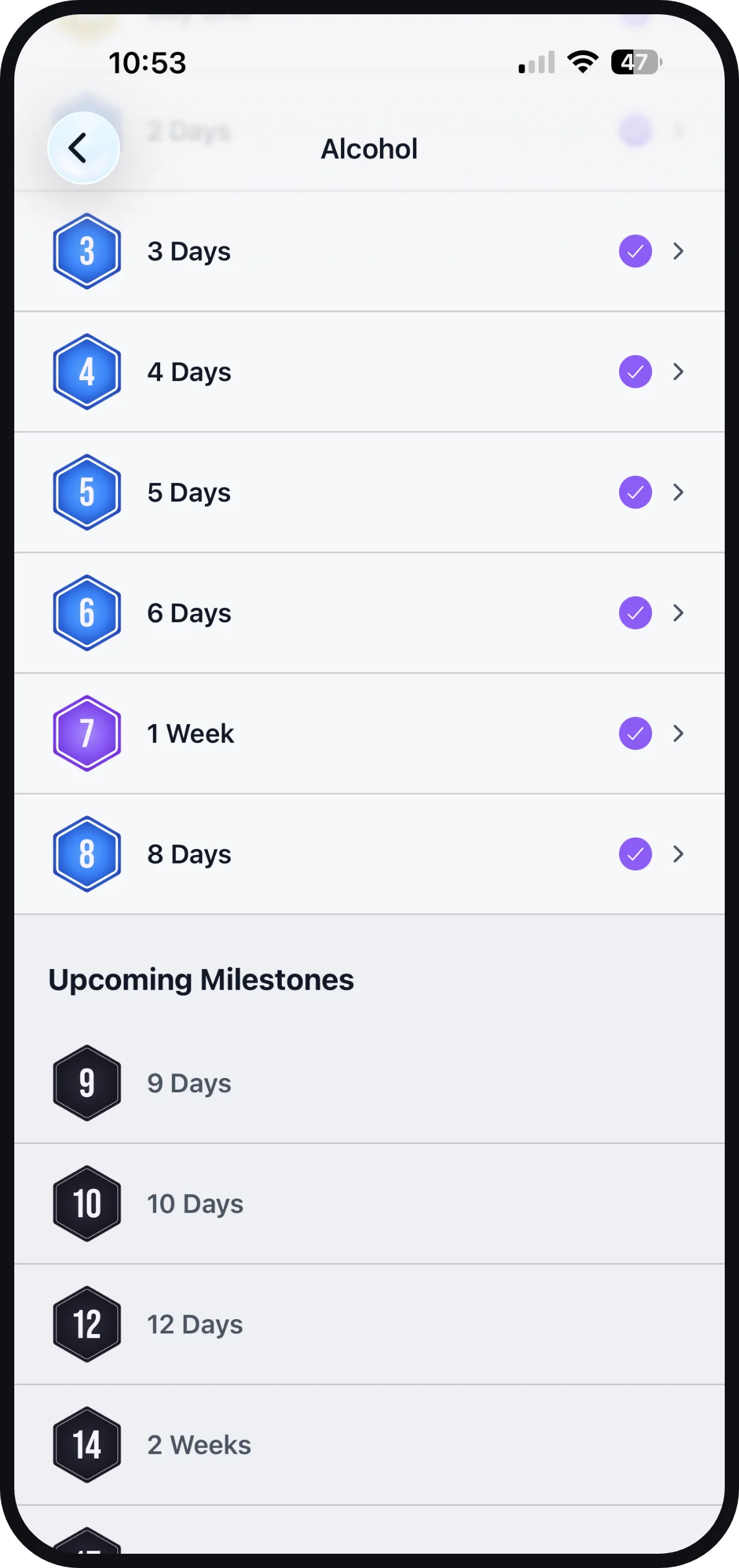
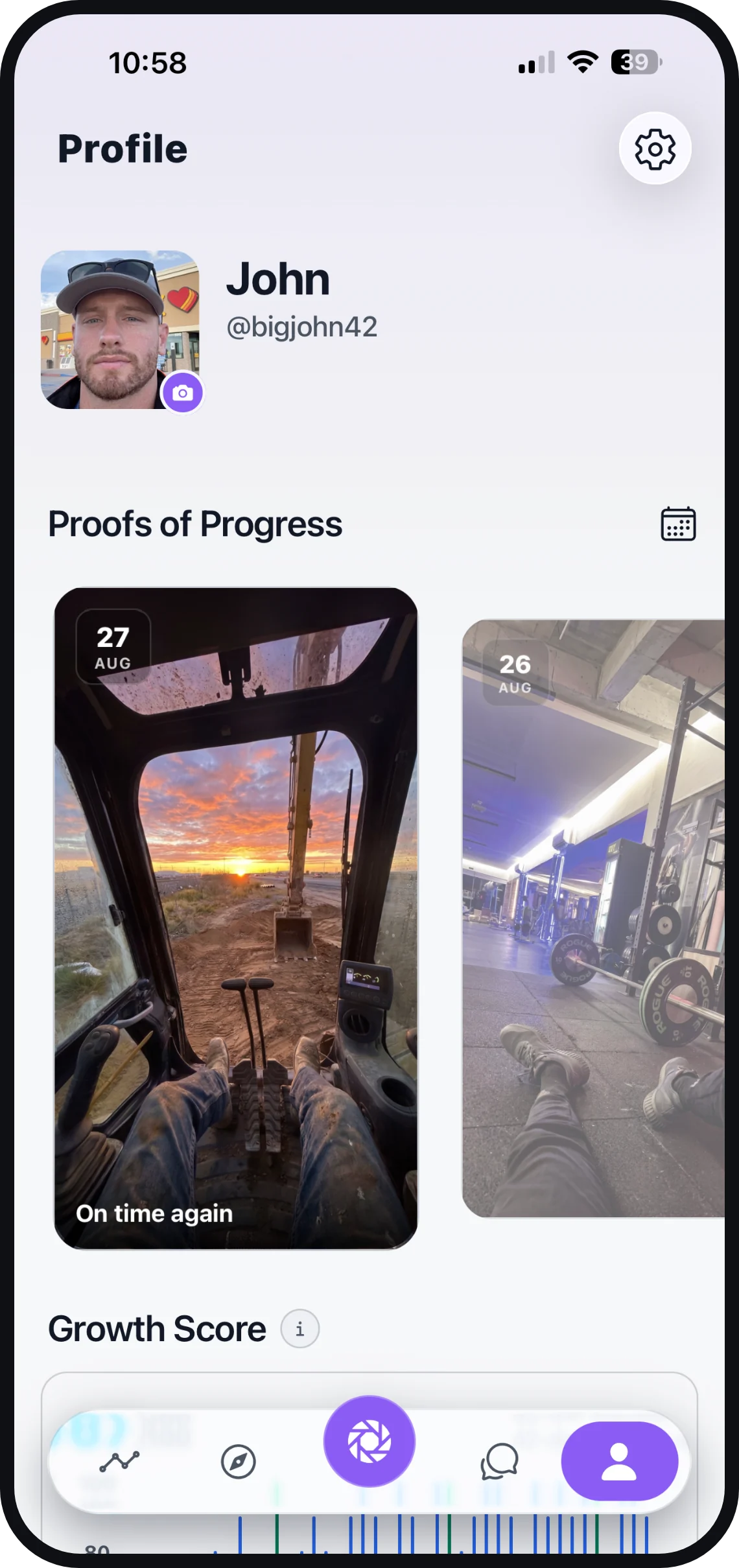
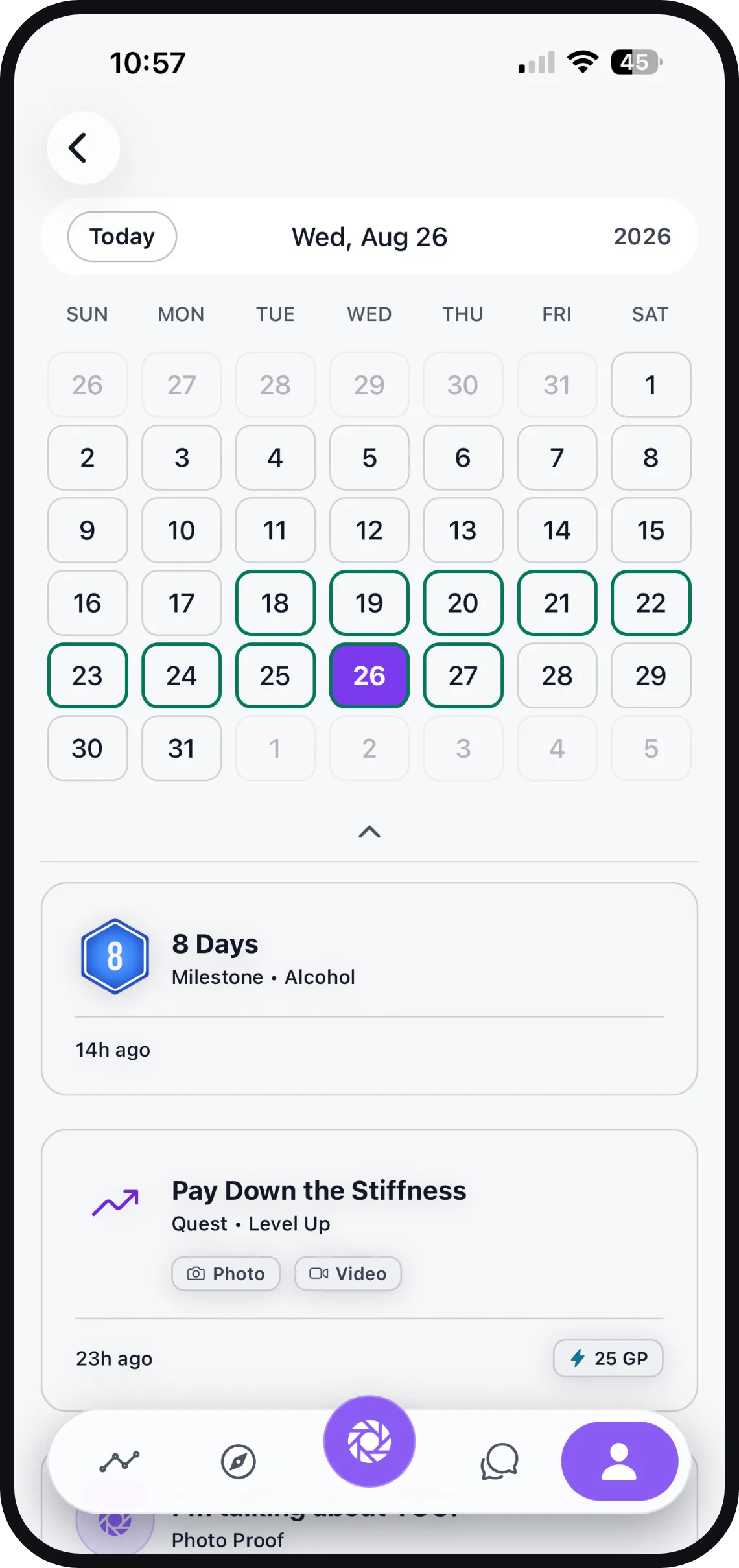
Door 24 is built around that difference. Every sober day becomes a Proof you capture, a photo, a video, a voice note, or a written entry, dated and stacked on your timeline. Your Growth Score reads consistency as a 42 day rolling average, so it moves with the trend and does not reset when a morning goes badly. The Freedom Ledger keeps the time and money you have reclaimed in view. A Daily Quest gives the morning one small action pointed at the version of you that is forming.
Six weeks in, open the timeline and scroll back. The Day 9 face and the Day 50 face are not the same face. You will not notice that from the inside, and you will not notice it from a number. You notice it from the record. For more on what that record is doing, read what the first 30 days of sobriety are like, or see how Door 24 works.
Abstinence is not enough. You do not just quit a habit. You become someone who no longer needs it, and mornings are where that person gets built, one unremarkable half hour at a time.
Counters reset. People don't.
Sources
- He, S., Hasler, B. P., & Chakravorty, S. (2019). Alcohol and Sleep-Related Problems. Current Opinion in Psychology, 30, 117-122.
- Brower, K. J., Aldrich, M. S., Robinson, E. A., Zucker, R. A., & Greden, J. F. (2001). Insomnia, Self-Medication, and Relapse to Alcoholism. American Journal of Psychiatry, 158(3), 399-404.
- Lally, P., van Jaarsveld, C. H. M., Potts, H. W. W., & Wardle, J. (2010). How are habits formed: Modelling habit formation in the real world. European Journal of Social Psychology, 40(6), 998-1009.
- Gollwitzer, P. M., & Sheeran, P. (2006). Implementation intentions and goal achievement: A meta-analysis of effects and processes. Advances in Experimental Social Psychology, 38, 69-119.
- National Institute on Alcohol Abuse and Alcoholism. Alcohol Use Disorder (AUD) in the United States. 2024 NSDUH.
- National Institute on Drug Abuse. Treatment and Recovery.
Frequently asked
What should I do first thing in the morning in early recovery?
Pick three or four small actions and do them in the same order every day. Water, light, movement, and a written or spoken check-in cover most of it. Keep the whole sequence under thirty minutes so it survives a bad night, and finish by capturing something dated so the morning leaves a record.
Why do I feel so bad in the morning even though I am not drinking?
Sleep usually gets worse before it gets better. Insomnia is common at every stage of alcohol use disorder, including recovery, and reported prevalence in people with AUD ranges from 36 to 91 percent compared with about 10 percent in the general population. Broken sleep produces the flat, irritable, foggy morning you are describing.
How long does it take a sober morning routine to become a habit?
Longer than three weeks. In a University College London study of 96 people, the median time to reach 95 percent of maximum automaticity was 66 days, with individual times ranging from 18 to 254 days. Consistency mattered more than intensity, and missing a single day did not measurably harm the process.
What if I miss a morning?
Do the next one. In the habit formation research, one missed opportunity had no meaningful effect on the eventual outcome. Treat a missed morning as a data point, not a verdict. What matters is the trend across weeks, which is why a rolling measure is more honest than a streak that resets to zero.
Is insomnia in early sobriety a reason to worry?
It is common, but persistent insomnia is worth raising with a doctor because it is a known risk factor for returning to drinking. Reviewing the field in Current Opinion in Psychology, He, Hasler and Chakravorty write that the recommended treatment for insomnia disorder, in the community and in people with alcohol use disorder, is cognitive behavioral therapy for insomnia.