Daily practice
How do I build sober habits that actually stick?
Sober habits stick when you attach them to a fixed context and give them a visible record. Habits are cued by stable surroundings, not by willpower, so a new routine holds when it has its own time, place, and trigger. Research puts the median time to automatic at 66 days. The habits that last are the ones you can prove you did.
Why do sober habits fall apart in the first month?
Most sober habits fall apart because they were built on intention instead of on a cue. You decide to walk in the mornings, journal at night, or call someone when the craving hits. Then a hard Wednesday arrives, the decision has to be made again, and the old routine is already running before you get a vote. The National Institute on Drug Abuse is blunt about the limits of resolve: quitting "usually takes more than good intentions or a strong will," because repeated use produces brain changes that make quitting hard even for people who want to stop.
That is not a character problem. It is an architecture problem. SAMHSA's 2025 National Survey on Drug Use and Health, released July 27, 2026, put past-year alcohol use disorder at 8.9 percent of people aged 12 and older, about 25.7 million people, down from 10.6 percent in 2021. Millions of people do change. They do not do it by wanting it harder. They do it by rebuilding the conditions around the behavior.
What actually makes a habit automatic?
A habit becomes automatic when the same action is repeated in the same context often enough that the context starts doing the deciding. NIDA describes the mechanism plainly in Drugs, Brains, and Behavior: the basal ganglia are "involved in the formation of habits and routines," and a burst of dopamine after a rewarding action "causes changes in neural connectivity that make it easier to repeat the activity again and again without thinking about it, leading to the formation of habits."
Wendy Wood and colleagues put it the same way from the psychology side. In their 2005 study in the Journal of Personality and Social Psychology, they wrote that "when people practice action, they develop associations in memory between the action and aspects of the context in which it typically occurs. With sufficient repetition in stable contexts, behavior comes to be triggered relatively automatically by these features of the performance context."
So a habit needs a home. Same time, same place, same lead-in. A behavior with no fixed context is not a habit. It is a plan you have to renew every day.
How do I break the cue that triggers the old habit?
You break the cue by removing it or by giving it something else to do. Wood, Tam and Guerrero Witt studied 115 students transferring to a new university, measuring their exercising, newspaper reading, and TV watching one month before and one month after the move. Roughly 70 percent moved to a new community. Their habits survived the transfer only when aspects of the performance context did not change. When the context changed, behavior went back under deliberate control.
Their recommendation for anyone trying to change a habit is worth quoting directly: "effective habit change interventions are likely to involve stimulus control, such as limiting exposure to stimulus cues, and response substitution, such as linking a competing response with the cues."
Stimulus control means changing the room, the route, the hour, the company. Response substitution means the 6 p.m. cue still fires, but now it pulls a different lever. Earlier work by Todd Heatherton and Patricia Nichols, cited in that same paper, found that about 36 percent of successful behavior change attempts involved moving to a new location, compared with 13 percent of unsuccessful ones. Their 1994 study collected 119 personal accounts of life change and found something else worth sitting with: the failure stories were the ones that described change in terms of willpower, while the success stories involved developing a new sense of identity that incorporated the changed behavior.
This is also why cravings ambush people who are doing well. NIDA notes that cues in a daily routine or environment linked to substance use "can trigger uncontrollable cravings whenever the person is exposed to these cues, even if the drug itself is not available," and that this learned reflex "can last a long time, even in people who haven't used drugs in many years." If you want the full map of what sets you off, read the most common relapse triggers.
How long does it take a sober habit to stick?
Longer than three weeks and less time than it feels like. In a 2010 study in the European Journal of Social Psychology, Phillippa Lally and colleagues at University College London asked 96 people to repeat one chosen eating, drinking, or activity behavior daily in the same context for 12 weeks. Time to reach 95 percent of maximum automaticity ranged from 18 to 254 days, with a median of 66 days.
Two things in that finding matter more than the number. The range is enormous, so comparing your week six to someone else's is meaningless. And the researchers found that missing a single opportunity did not materially affect the habit formation process. One missed day is not a reset. It is one missing entry in a long record.
What does a sober habit that sticks look like?
It looks like five decisions made once instead of a decision made daily.
| The move | What the research shows | What it looks like on a Tuesday |
|---|---|---|
| Give it one fixed context | Habits survived a university move only when the performance context stayed the same (Wood, Tam & Guerrero Witt, 2005) | The walk happens at 7 a.m., from the same door, before the phone comes on |
| Remove the old cue | Stimulus control means limiting exposure to the cues that trigger the old routine (Wood et al., 2005) | The route home no longer passes the store. The glassware is out of the house |
| Substitute a competing response | Response substitution links a new behavior to the existing cue (Wood et al., 2005) | 6 p.m. still means "pour something." Now it is a kettle |
| Repeat past the boredom | Median 66 days to automatic, range 18 to 254; one missed day did not matter (Lally et al., 2010) | Day 40 feels like nothing is happening. Do it anyway |
| Leave evidence behind | Cue-triggered urges can persist for years, so the habit needs proof it is working (NIDA) | Capture one Proof. Photo, voice note, or two lines of text |
That last row is the one most people skip, and it is the one that decides whether the habit survives a bad month. A habit you completed and forgot has no defense on the day you feel like nothing has changed.
How does Door 24 keep a habit visible?
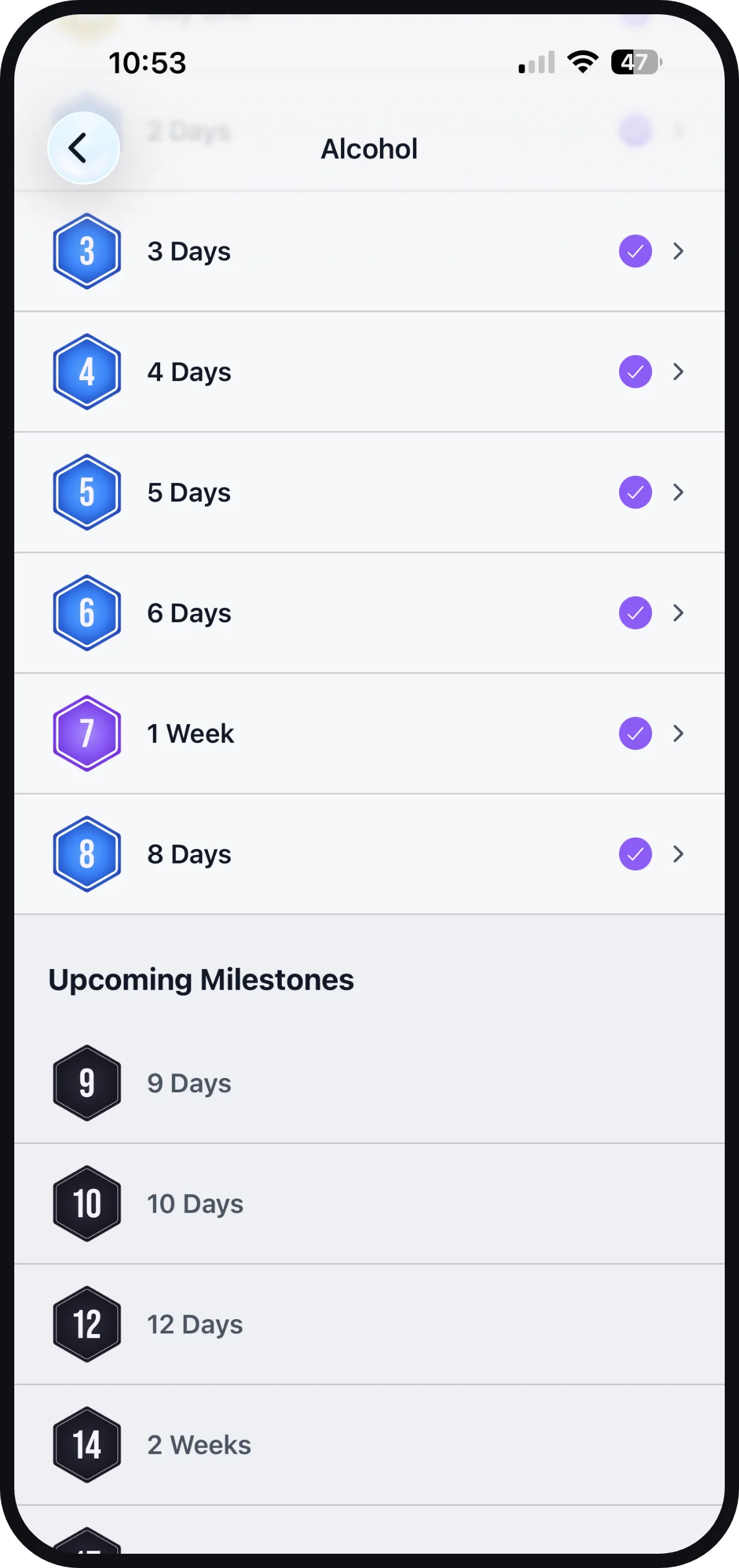
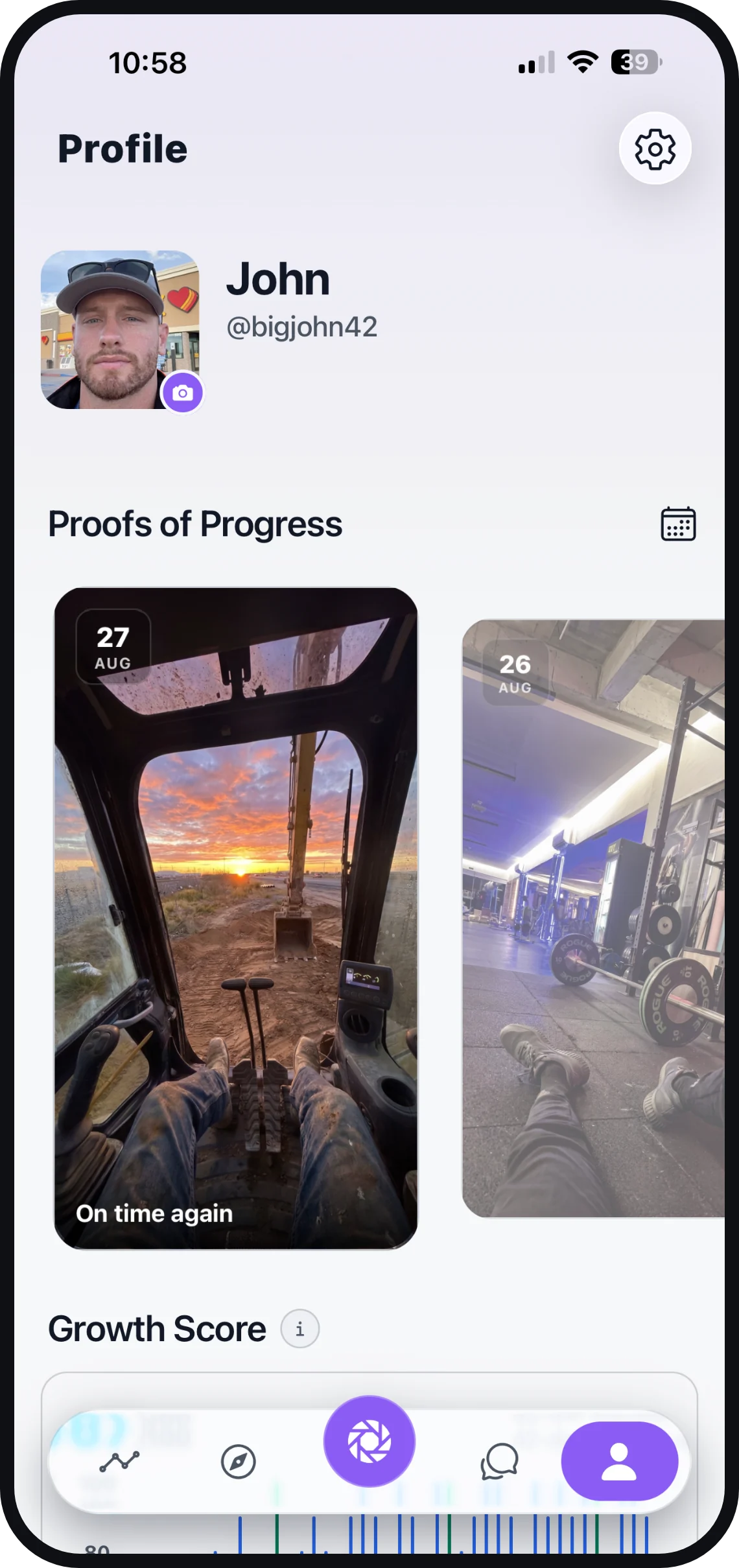
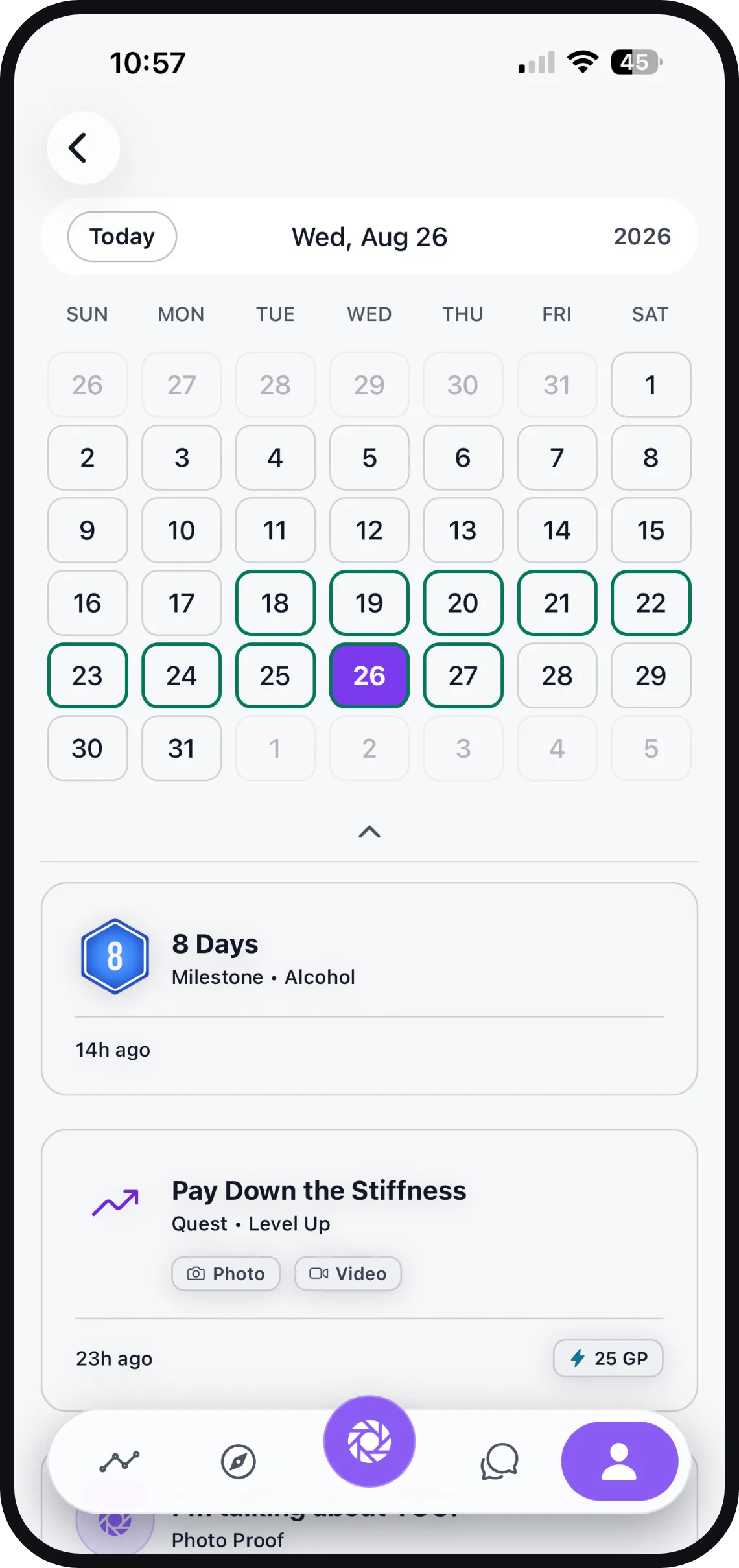
Door 24 is built on the idea that progress is proof. Every day you follow through, you capture a Proof: a photo, a video, a voice note, or a journal entry, timestamped and stacked on a dated timeline. Six weeks in, the habit is not a feeling anymore. It is a grid you can scroll.
Your Growth Score is a 42-day rolling average of consistency, not a fragile streak. It moves with the trend instead of snapping to zero and deleting the record after one hard day. Your Freedom Ledger shows the money and time you have reclaimed, and the Daily Quest gives the habit a cue that arrives on its own.
Remember what the failure stories had in common. They described change as willpower. The success stories described a new identity. Abstinence is not enough. Habits are what you build in the space stopping opens up, and the person on the other side of them no longer needs the old routine. For a starting structure, read what a daily sobriety routine should look like and what a morning routine in early recovery looks like. When you are ready to start stacking evidence, get Door 24.
Sources
- National Institute on Drug Abuse, Understanding Drug Use and Addiction DrugFacts (updated March 9, 2026)
- National Institute on Drug Abuse, Drugs, Brains, and Behavior: The Science of Addiction, Drugs and the Brain (updated March 9, 2026)
- Wood, W., Tam, L., & Guerrero Witt, M. (2005). Changing circumstances, disrupting habits. Journal of Personality and Social Psychology, 88(6), 918 to 933
- Lally, P., van Jaarsveld, C. H. M., Potts, H. W. W., & Wardle, J. (2010). How are habits formed: modelling habit formation in the real world. European Journal of Social Psychology, 40(6), 998 to 1009
- Heatherton, T. F., & Nichols, P. A. (1994). Personal accounts of successful versus failed attempts at life change. Personality and Social Psychology Bulletin, 20(6), 664 to 675
- Substance Abuse and Mental Health Services Administration, 2025 National Survey on Drug Use and Health (released July 27, 2026)
Frequently asked
How long does it take to build a sober habit?
In a 2010 University College London study of 96 people, the time to reach 95 percent of maximum automaticity ranged from 18 to 254 days, with a median of 66 days. Treat 66 days as a midpoint, not a deadline. Simple daily actions land faster than complex ones.
Does missing one day ruin a new habit?
No. In that same study, missing a single opportunity did not materially affect the habit formation process. One skipped day is a gap in a record, not the end of it. What breaks a habit is abandoning the context, not missing a Tuesday.
Why do old habits come back even after months sober?
Because the cue outlives the behavior. NIDA notes that cues linked to substance use can trigger cravings long after the substance is gone, even in people who have not used in many years. The habit is not weak character. It is a stored association waiting for its trigger.
Is it easier to build sober habits after moving or changing jobs?
Often, yes. Research on students transferring universities found that habits survived the move only when the performance context stayed the same. A genuine change of setting removes the cues that used to run the old routine automatically, which briefly puts your behavior back under deliberate control.
What is the difference between a streak and a habit?
A streak counts days you avoided something. A habit is a behavior your environment triggers without much effort. Streaks reset to zero and delete the record. A habit you have documented leaves evidence behind, which is why Door 24 stacks dated Proofs instead of counting.