Daily practice
How does journaling help in addiction recovery?
Journaling helps in addiction recovery by giving difficult thoughts somewhere to go and leaving a record you can reread. Randomized research in residential treatment found that structured writing reduced posttraumatic symptoms, depression, and anxiety in the short term. It works as an addition to treatment, not a replacement for it. Its quieter power is cumulative: dated entries become evidence of who you are becoming.
Most people are told to journal in early recovery and nobody explains why. It sounds like homework. Here is the actual case for it, including the parts the research does not support.
How does journaling help in addiction recovery?
Journaling helps in addiction recovery mainly by processing the emotional load underneath the habit, not by acting directly on the habit. The best studied version is expressive writing, developed by James Pennebaker. In the first study on it, Pennebaker and Beall had students write for 15 minutes on four consecutive days about the most upsetting experiences of their lives. Four months later those students were visiting the health center less often. The authors concluded that "writing about earlier traumatic experience was associated with both short-term increases in physiological arousal and long-term decreases in health problems."
That matters here because emotion is where relapse starts. It also matters at scale: 27.9 million Americans ages 12 and older, or 9.7 percent, had alcohol use disorder in 2024 according to NIAAA, and most of them will never sit in a therapist's office. A notebook is available at 2am.
What does the research on journaling and recovery actually show?
Real effects, modest size, and smaller in clinical groups than in healthy ones. Karen Baikie and Kay Wilhelm summarized the field in Advances in Psychiatric Treatment in 2005. Here is what the studies closest to recovery found.
| Study | What was tested | What it found |
|---|---|---|
| Smyth 1998 meta-analysis, 13 studies | Expressive writing in healthy adults | Significant overall benefit, d = 0.47 |
| Frisina et al. 2004 meta-analysis, 9 studies | Expressive writing in clinical populations | Smaller benefit, d = 0.19; physical health d = 0.21, psychological health in psychiatric samples not significant |
| Meshberg-Cohen et al. 2014, 149 women, randomized | 20-minute daily expressive writing vs control writing in residential treatment | Greater drops in posttraumatic symptom severity, depression, and anxiety at 2 weeks; no group difference at 1 month |
| Krentzman et al. 2022, 15 women, single group | Eight sessions of structured positive journaling plus 2 weeks alone | Confidence in staying sober and depression improved; authors say the design cannot show cause |
The Meshberg-Cohen trial, published in Substance Abuse in 2014, is the strongest single piece of evidence: a randomized clinical trial of 149 women in residential treatment. The gains were real at two weeks and gone at one month. That is not a reason to skip journaling. It is a reason to keep doing it rather than treating it as a four-day cure.
Does journaling reduce drinking or drug use by itself?
There is no strong evidence that it does, and pretending otherwise would be dishonest. Baikie and Wilhelm note that expressive writing generally does not change health behaviors such as exercise, diet, or alcohol and drug use. They are direct about the role it should play: writing "should not replace appropriate medical or psychological treatment in clinical populations; it should be used as an adjunct to standard treatment."
So journaling is not a substitute for care. If you drink heavily or daily, stopping suddenly can be medically serious, so talk to a doctor before you quit.
What journaling does do is work on the layer underneath. NIDA reports relapse rates of 40 to 60 percent for substance use disorders, and the most common precursors are emotional states, not chemical ones. If you want the mechanism, we broke it down in why you crave alcohol when you are stressed.
What should you actually write about?
Not just the wreckage. Amy Krentzman and colleagues at the University of Minnesota tested a structured format called Positive Peer Journaling with 15 women in residential treatment, published in The Journal of Positive Psychology in 2022. Each entry looked back with four prompts, good things that happened, bad things that happened, things I am grateful for, and wishes for others, then planned the coming day across areas like work, home, joy, health, recovery, and community.
Participants averaged 39 bullet points per entry. Notably, the good things and gratitude items outnumbered the bad things by more than five to one. Confidence in staying sober rose (p = .004), self-rated happiness with recovery rose (p = .012), and depression scores fell by 2 points (p = .012). The authors are careful about what that means, and so are we. They write: "This study did not have a comparison group, and changes occurred in the context of residential treatment for addiction; we cannot, therefore, conclude that PPJ caused the observed changes."
Fifteen people, no control group, everyone in treatment at the same time. Promising, not proven. But the format itself is free, and the balance of it is the useful part: you are not only cataloging damage, you are noticing what is working.
How long should a journaling practice last?
Longer than the studies. The classic protocol is 15 to 20 minutes on three to five occasions, which is a research design, not a life. Baikie and Wilhelm suggest capping a session at 20 minutes so it does not feel overwhelming and allowing about 10 minutes afterward to settle. Expect the first sessions to feel worse, not better. That short-term dip is the normal pattern, and in the 149-woman trial it did not carry into the next day.
The bigger reason to keep going is what accumulates. A single entry is a mood. Sixty entries are a record. That is the difference between venting and evidence, and it is where a journal stops being a diary. If you want a place to put it in the day, see what a daily sobriety routine looks like.
Why is a dated journal better than a day counter?
Because a counter measures what you avoided and a journal measures who you became. Most apps in this category hand you a number that resets to zero the moment you slip, erasing months of real work over one bad night.
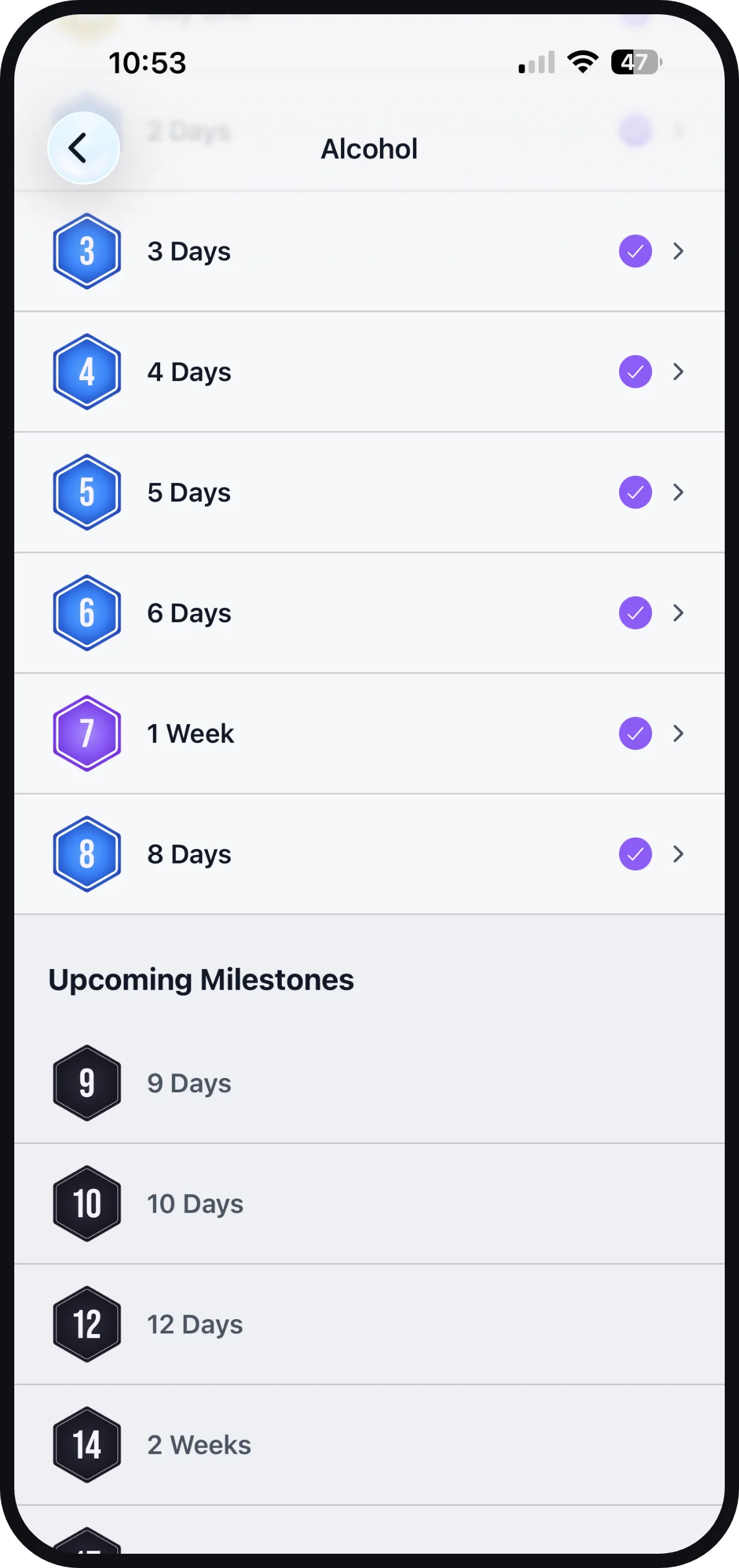
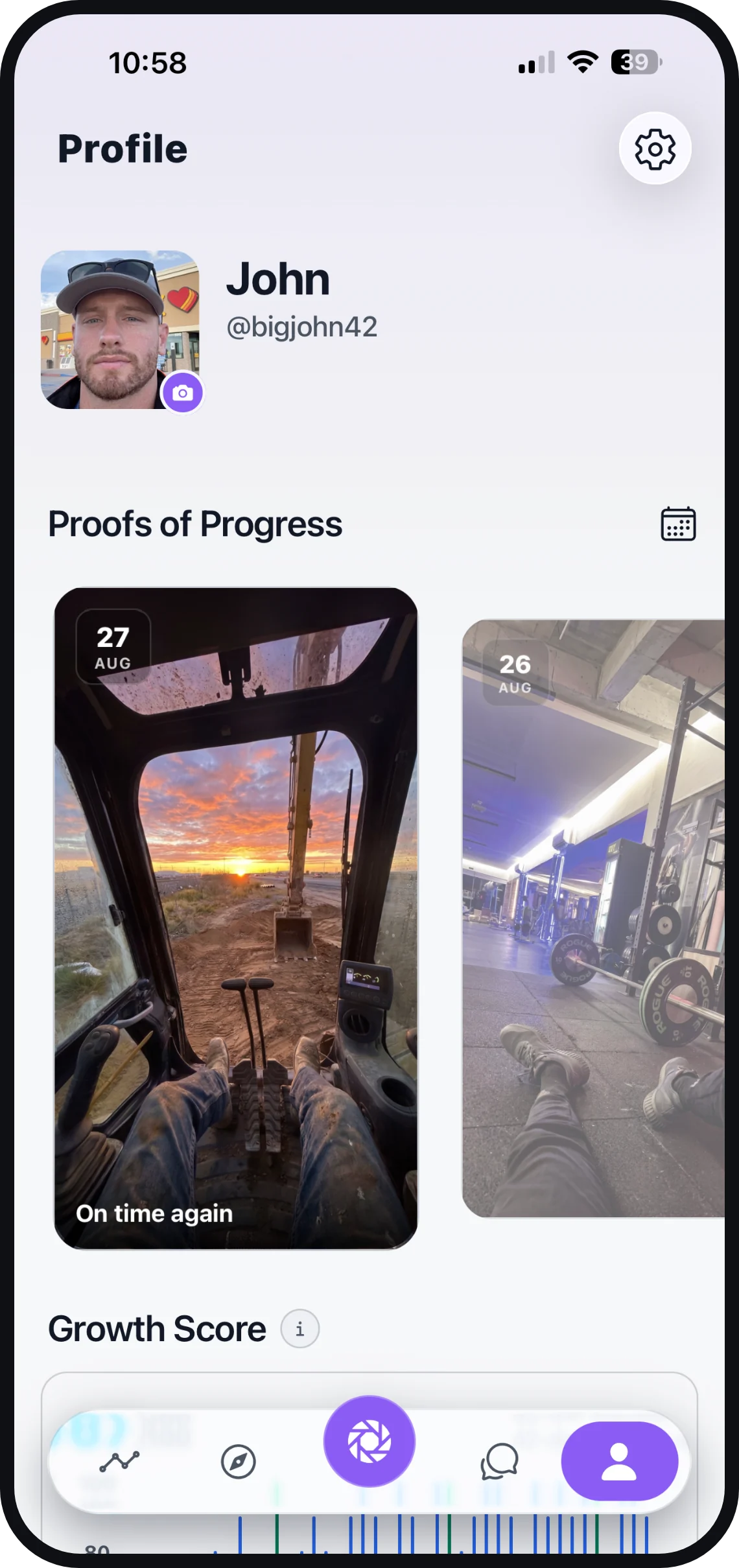
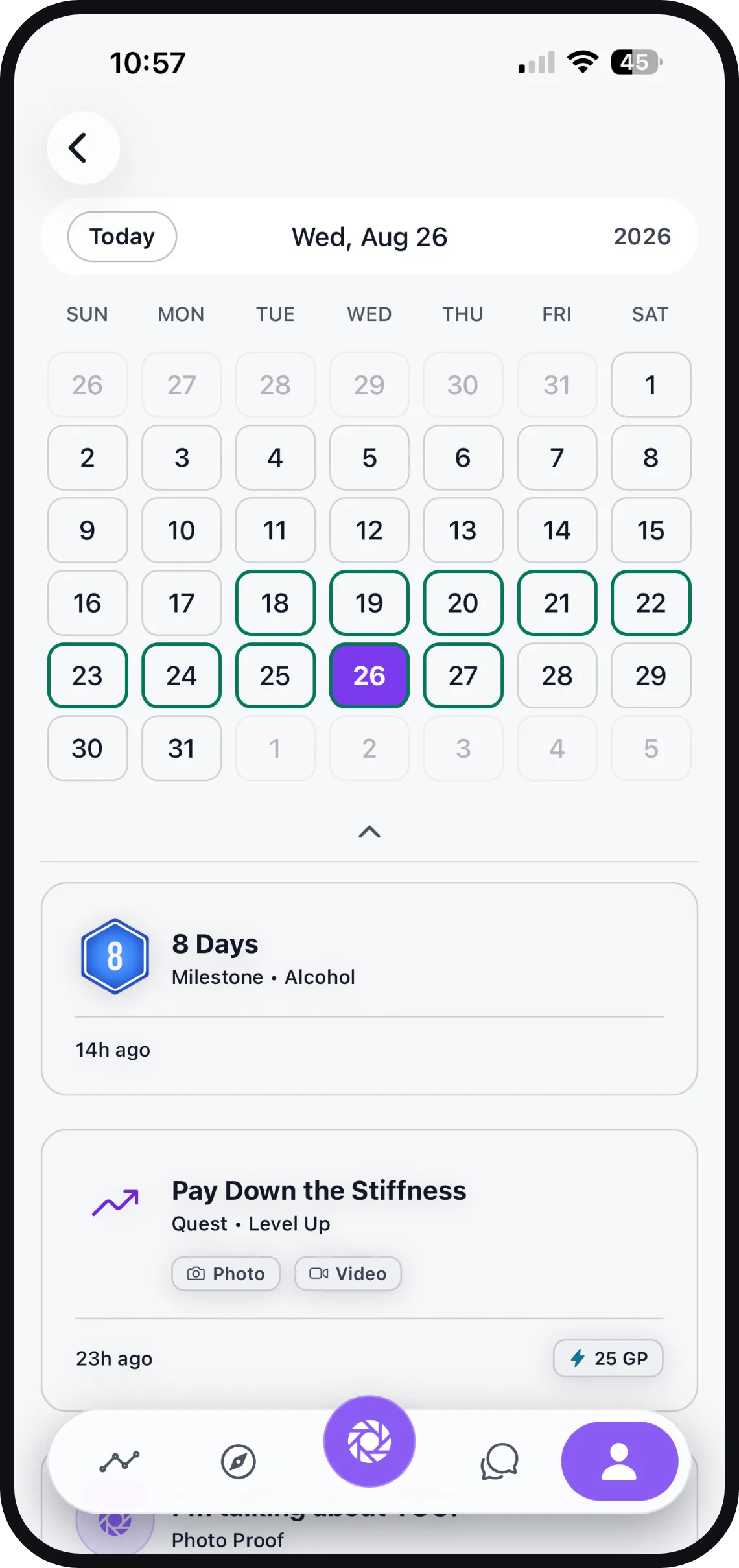
Door 24 was built the other way. Every sober day becomes a Proof you capture, a photo, a video, a voice note, or a written entry, and it lands dated on your timeline. Your Growth Score reads consistency as a 42-day rolling average, so it moves with the trend instead of resetting, and a hard day shifts the line without deleting the evidence behind it. The Freedom Ledger keeps the time and money you have reclaimed in view. Scroll back to Day 12 and read what you wrote. That version of you was barely holding on. Compare it to today.
That is the whole argument for writing things down in recovery. Abstinence is not enough. You do not just quit a habit, you become someone who no longer needs it, and becoming leaves a paper trail. Read more on rebuilding your identity in recovery, or see how Door 24 works.
Counters reset. People don't.
Sources
- Baikie, K. A., & Wilhelm, K. (2005). Emotional and physical health benefits of expressive writing. Advances in Psychiatric Treatment, 11, 338-346.
- Meshberg-Cohen, S., Svikis, D., & McMahon, T. J. (2014). Expressive writing as a therapeutic process for drug-dependent women. Substance Abuse, 35(1), 80-88.
- Krentzman, A. R., Hoeppner, B. B., Hoeppner, S. S., & Barnett, N. P. (2022). Development, feasibility, acceptability, and impact of a positive psychology journaling intervention to support addiction recovery. The Journal of Positive Psychology, 18(4), 573-591.
- National Institute on Alcohol Abuse and Alcoholism. Alcohol Use Disorder (AUD) in the United States. 2024 NSDUH.
- National Institute on Drug Abuse. Treatment and Recovery.
Frequently asked
Does journaling help you stay sober?
Journaling has good evidence for the emotional side of recovery and thin evidence for drinking itself. Trials show reductions in depression, anxiety, and posttraumatic symptoms, but early expressive writing research found no reliable effect on health behaviors like alcohol and drug use. Treat it as support for the work, not as the work.
What should I write in a recovery journal?
Two things: what happened, and what is next. A journaling study in residential treatment used four daily prompts looking back, good things that happened, bad things that happened, things I am grateful for, and wishes for others, then a short plan for the coming day across areas like health, home, recovery, and social life.
How long should I journal each day?
The standard expressive writing protocol is 15 to 20 minutes on three to five occasions, often consecutive days. Researchers recommend capping a session at 20 minutes so the task does not feel overwhelming, and leaving about 10 minutes afterward to settle before moving on.
Can journaling make you feel worse?
In the short term, yes, and that is expected. Writing about painful events usually produces an immediate rise in negative feeling. In a randomized trial with 149 women in residential treatment, that spike did not carry over: negative affect before the next day's session was no different between groups. If writing brings up more than you can hold, stop and come back to it another day.