Getting sober
How do I stop gambling?
To stop gambling, do three things in order: cut off access through self-exclusion and account closures, turn off every marketing message the operators send you, and put a daily structure in the hours you would have been betting. Access controls buy you the moment. Structure is what fills the months after, which is where most people actually come unstuck.
Gambling is the only habit that pays you back just often enough to keep the argument alive. That is not a metaphor. It is the design.
How do I stop gambling?
To stop gambling, work in this order. Close the accounts and register for self-exclusion, so that acting on an urge takes twenty minutes rather than twenty seconds. Then turn off every marketing message the operators send you, because those messages are engineered to reach you on exactly the day you have gone quiet. Then build something into the hours you used to spend betting, because an empty Saturday afternoon with a phone in it is not a plan.
Most advice stops after the first step. The first step is the easiest one and the one that fails quietest.
Turn off the marketing first
If you do one thing today, do this one, because the evidence behind it is unusually strong and unusually specific.
In a randomised experiment published in Addiction in 2026, Matthew Rockloff and colleagues had 227 regular Australian bettors either opt out of direct marketing from their wagering operators or continue receiving it as normal, then tracked them for a fortnight. The group who opted out placed 23 percent fewer bets, spent 39 percent less money, and reported 67 percent fewer gambling harms than the group still receiving the emails, texts and push notifications. Just over half the sample scored as moderate risk or problem gamblers on the standard screening index.
Sit with that third number. Turning off the notifications cut reported harms by two thirds, without any change in willpower, therapy or intention. You are not just quitting a habit. You are leaving a product with a retention budget, and the single cheapest thing you can do is stop letting it contact you.
What makes this one stickier than other habits
The losses argue for more. Every other vice gets less appealing as it goes badly. This one hands you a reason to continue: the idea that the next bet makes the last one not count.
Near misses feel like progress. Luke Clark and colleagues showed in Neuron in 2009 that near miss outcomes recruit the same reward circuitry as actual wins and increase the motivation to keep playing. A later study by Henry Chase and Clark, published in the Journal of Neuroscience in 2010, found that the strength of that midbrain response scales with the severity of someone's gambling. The worse it has got, the more a near miss does to you.
It hides. No smell, no bottles, nothing anyone can see. It can run for years beside a life that looks entirely fine from the outside, which means nobody asks, which means nothing interrupts it.
How common this is, honestly
In a systematic review and meta-analysis of 342 studies across 68 countries, published in The Lancet Public Health in 2024, Le Tran and colleagues estimated the pooled prevalence of problem gambling in North America at 4.7 percent of adults. Broken down by activity, online casino games and slots carried the highest problem gambling estimate at 15.8 percent.
In Great Britain, the Gambling Commission's Gambling Survey for Great Britain, covering 19,714 adults across 2024, found 2.7 percent of all adults scoring 8 or above on the Problem Gambling Severity Index, with a further 3.1 percent in the 3 to 7 band.
You are not an outlier, and you do not need a diagnosis to decide that this is taking more than it gives.
What works, and what the research is honest about
| Approach | What the evidence shows | Where it falls short |
|---|---|---|
| Cognitive behavioural therapy | Large effect on gambling severity straight after treatment. In an umbrella review and meta-analysis in Clinical Psychology Review in 2023, Rory Pfund and colleagues reported a Hedges g of 0.91 versus minimal or no treatment. | The advantage was no longer statistically significant at follow up. Getting to a good place is better evidenced than staying there. |
| Brief interventions | In a meta-analysis in PLOS ONE in 2019, Lena Quilty and colleagues found brief interventions of three sessions or fewer produced a small but significant reduction in gambling behaviour. | Effects on gambling problems and at long term follow up were not significant. |
| Self-exclusion | Real friction, widely used, and the sensible first move. | 49 percent breached it in Hakansson's 2023 Swedish survey. It is a delay, not a door. |
| Turning off operator marketing | 23 percent fewer bets, 39 percent less spend, 67 percent fewer harms in Rockloff's 2026 randomised experiment. | Requires you to actually do it, on every account, including the ones you forgot about. |
| Blocking software | Widely recommended. | No study has quantified whether it changes behaviour. GambleAware's own evaluation states it could not assess how many people the software works for. Use it, but do not lean on it. |
Read the first row and the third together and you get the honest picture. The treatments that work best work best in the short run, and the access controls leak. Neither of those is a reason to skip them. Both are reasons to build something that runs daily, in the gap those two leave.
Where the days actually get won
The urge does not usually arrive at random. For most people it clusters: payday, any live fixture, and late at night after a loss when the apps are still open and the argument for one more is loudest. That is three or four predictable windows a week, not a permanent state of siege.
Name them. Then decide in advance what happens in each one, before the moment arrives, because the moment is the worst time to be inventing options.
One thing worth knowing: you will read a lot of confident claims online that a gambling urge lasts fifteen or twenty minutes. We looked for a study behind that number and could not find one. It appears to originate on treatment centre marketing pages rather than in the literature. Urges do pass. Nobody has established how long yours takes, so build a plan around having something to do rather than around waiting out a stopwatch.
Make the days you walked away visible
Here is the specific problem with counting days when the habit is gambling. The whole psychology of chasing is that the past does not count, only the next one does. A day counter that resets to zero after a slip is running on exactly the same logic as the thing you are trying to leave: one event, everything before it erased.
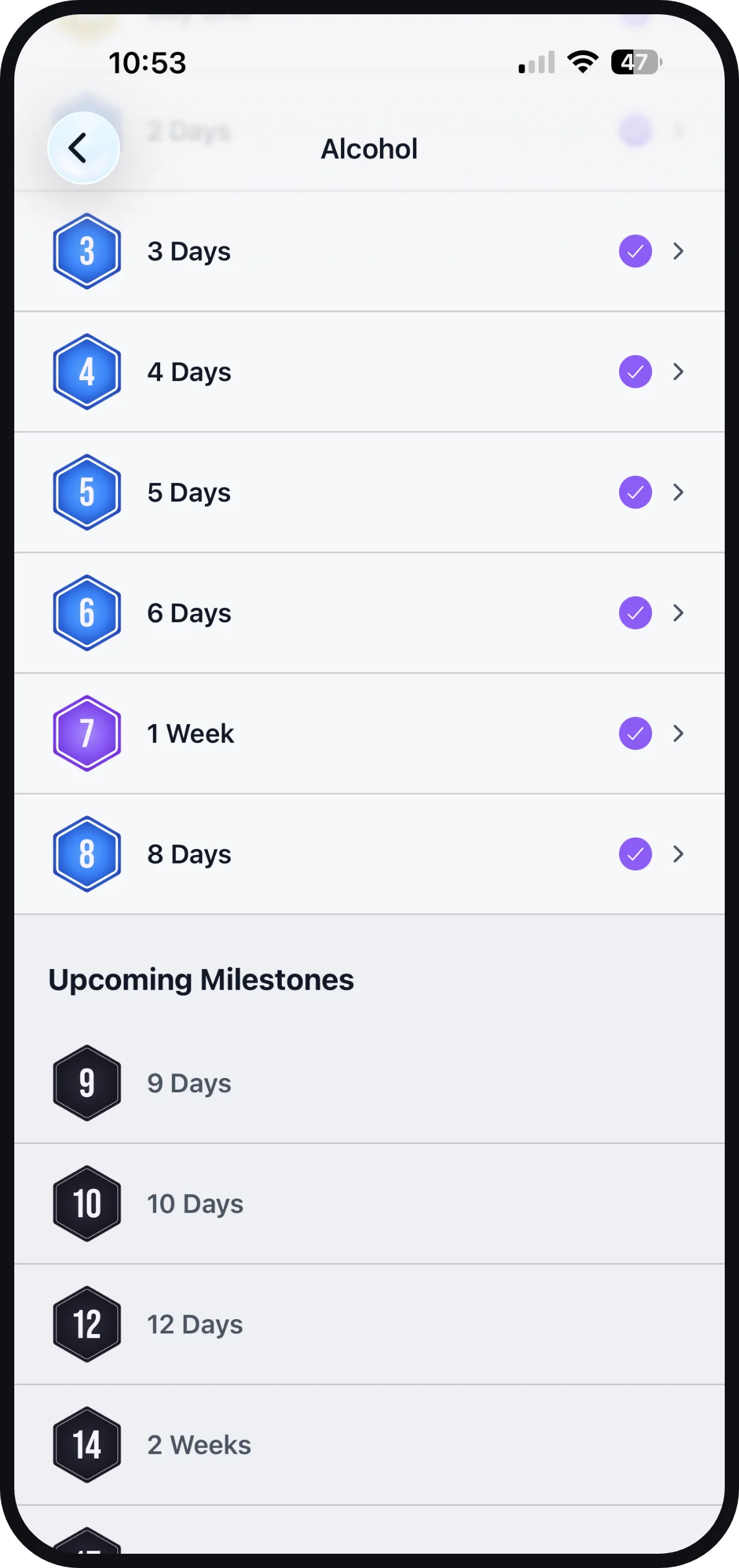
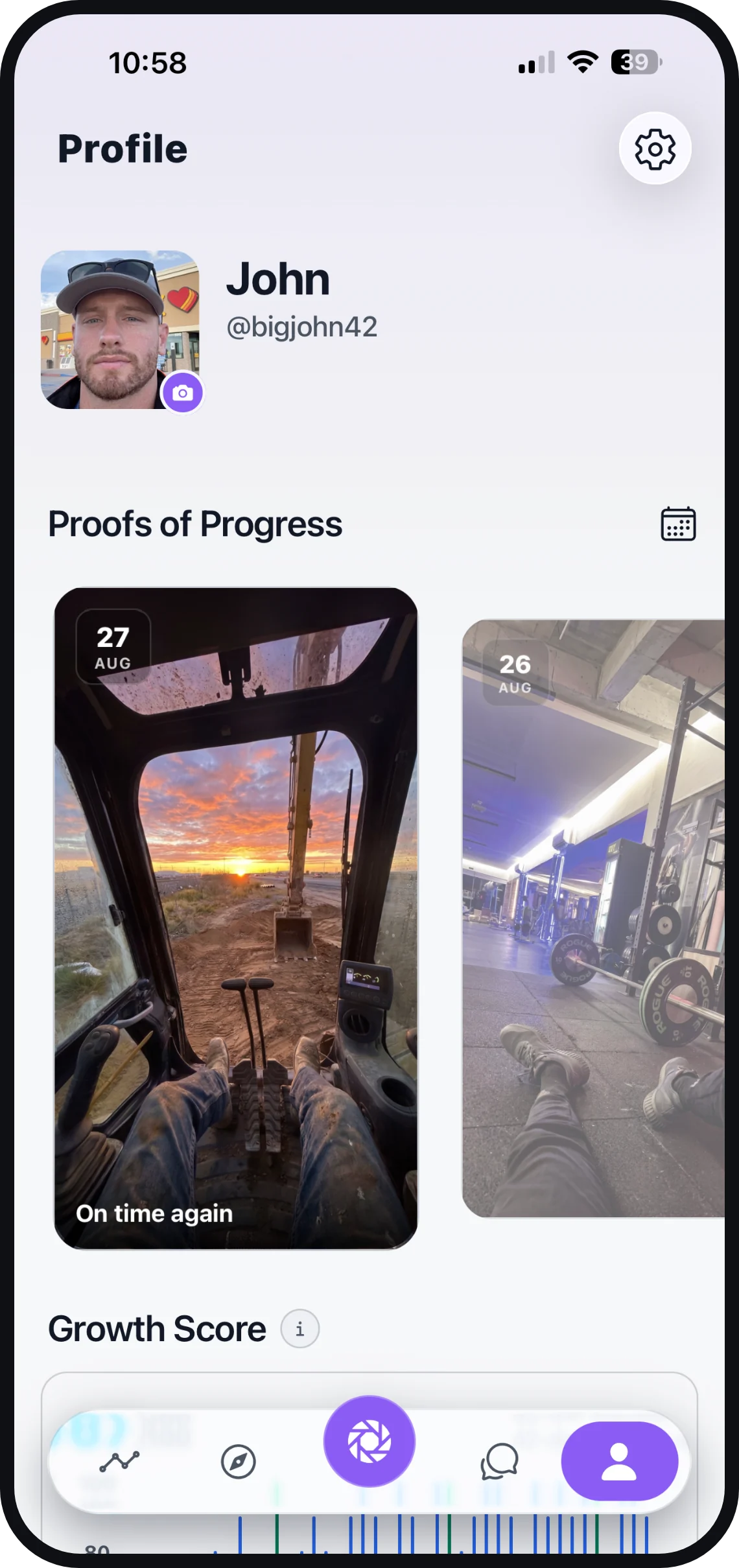
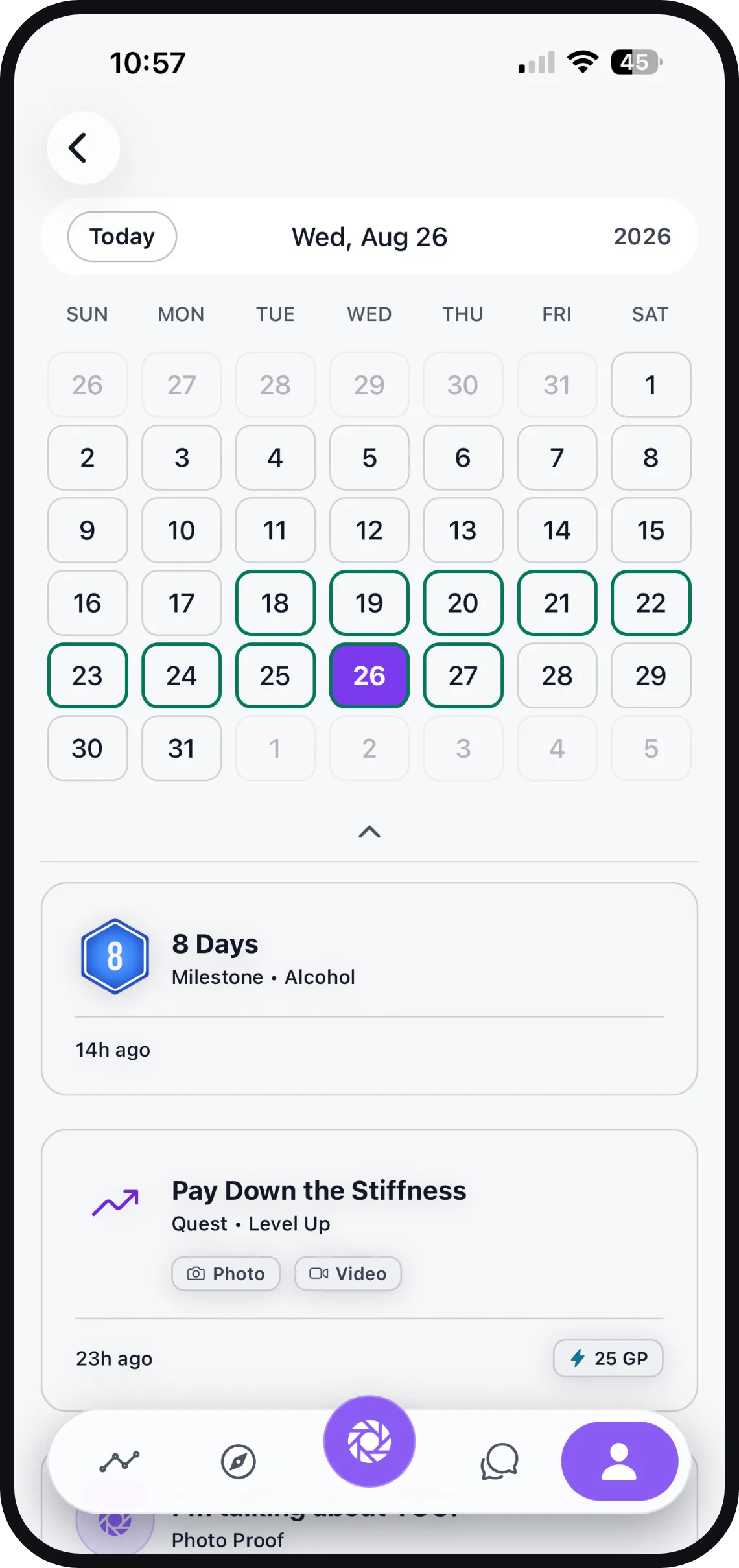
Door 24 is built on the opposite idea. Progress is proof. You capture a Proof, a photo, a voice note, a line of text, timestamped onto a dated timeline. The Sunday you watched the game and did not have money on it. The notification you deleted. The payday that stayed in the account. Your Growth Score is a 42 day rolling average, so one night bends the trend rather than deleting the record. When the argument in your head says none of this counts, you have a timeline that says otherwise.
The Freedom Ledger matters more here than for almost anything else, because gambling is the habit where the real number is hidden by the wins you remember. Not the good weekends. The total actually put through, and what it comes to over a year.
Door 24 is not a blocker and does not pretend to be. Use self-exclusion for access. Use this for the day after.
If you are working out where to start, read how to build sober habits that stick and how to get through cravings without relapsing. If you have already had a setback, what to do after a relapse is the more useful page, and how Door 24 approaches quitting gambling covers the product side.
If gambling has affected your finances, your relationships or your safety, this is worth taking to a professional who treats gambling disorder specifically. The National Council on Problem Gambling maintains directories of accredited help. Asking early is not an overreaction, and the data on how few people ever ask suggests most of us wait far too long.
Sources
- Rockloff M et al., "Direct gambling marketing, direct harm: A randomised experiment," Addiction, 2026.
- Tran LT et al., "The prevalence of gambling and problematic gambling: a systematic review and meta-analysis," The Lancet Public Health, 2024.
- Gambling Commission, "Gambling Survey for Great Britain, Annual Report 2024," Official Statistics, 2025.
- Pfund RA et al., "Cognitive-behavioral treatment for gambling harm: Umbrella review and meta-analysis," Clinical Psychology Review, 2023.
- Quilty LC et al., "Brief interventions for problem gambling: A meta-analysis," PLOS ONE, 2019.
- Hakansson A, "Self-exclusion and breaching of self-exclusion from gambling," Harm Reduction Journal, 2023.
- Slutske WS, "Natural Recovery and Treatment-Seeking in Pathological Gambling," American Journal of Psychiatry, 2006.
- Clark L et al., "Gambling Near-Misses Enhance Motivation to Gamble and Recruit Win-Related Brain Circuitry," Neuron, 2009.
- Chase HW and Clark L, "Gambling Severity Predicts Midbrain Response to Near-Miss Outcomes," Journal of Neuroscience, 2010.
Frequently asked
Does self-exclusion actually work?
It helps, and it is worth doing, but it is not a wall. In a survey of Swedish gamblers published in Harm Reduction Journal in 2023, Anders Hakansson found that 49 percent of people who had registered with the national Spelpaus self-exclusion scheme had gambled anyway. Of those who breached it, 82 percent did so through online casino games. Treat self-exclusion as friction that buys you time, not as a solved problem.
Can I stop gambling without treatment?
Many people do. In two nationally representative US surveys analysed by Wendy Slutske and published in the American Journal of Psychiatry in 2006, roughly a third of people with a lifetime history of pathological gambling recovered without formal treatment, and only 7 to 12 percent had ever sought help. That is genuinely encouraging. It is also an argument for building your own structure rather than waiting until things get bad enough to justify asking.
Why do I keep chasing losses?
Because the machine is built to make the next bet feel like the fix for the last one. Research by Luke Clark and colleagues, published in Neuron in 2009, showed that near misses, the losses that come close to a win, activate reward circuitry in the brain and increase the motivation to keep playing, even though they are objectively losses. Chasing is not a character flaw. It is the designed response to a designed stimulus.
Is Door 24 a gambling blocker?
No, and it is worth being straight about that. Blockers and self-exclusion schemes handle access. Door 24 handles the part that comes after: the daily structure, the record of the days you walked away, and people who notice whether you showed up. Plenty of people use both, and that is the sensible combination.