Tools & tracking
Do sobriety apps actually work?
Sobriety apps work, with a condition attached. A 2025 review of 34 randomized trials found that remote and digital tools added to in-person treatment were associated with 39 percent lower odds of relapse. Used entirely alone, the evidence is thinner, and most apps in this category are abandoned within a month. What separates the ones that help is whether you keep opening them.
Search "sobriety app" and you get thousands of results and almost no evidence. Here is what the research actually says, including the parts that are not flattering.
Do sobriety apps actually work?
Yes, when they add to your support rather than stand in for it. The strongest recent evidence is a systematic review and meta-analysis by Irene Kwan and colleagues, published in Addiction in 2025. The team searched 29 databases and pooled 34 randomized controlled trials covering 6,461 adults diagnosed with an alcohol or drug use disorder across OECD countries between 2004 and 2023.
When remote or digital tools supplemented in-person care, the odds of relapse were 39 percent lower than in-person care alone (17 interventions, odds ratio 0.61, 95 percent CI 0.46 to 0.81). Days of use fell too, though modestly (standardized mean difference -0.18). Their conclusion, verbatim: "Remote interventions which supplement in-person alcohol/drug treatment appear to reduce relapse and days of use."
That sentence is doing careful work, and the authors close on an even more careful one. "High risk-of-bias means findings should be interpreted with caution," they write, because more than 70 percent of the outcomes they appraised were judged high risk of bias. This is real evidence, not a guarantee.
What does the strongest single trial show?
The landmark trial is still Gustafson et al. in JAMA Psychiatry, 2014. Researchers randomized 349 adults leaving residential alcohol treatment to usual continuing care, or usual care plus a smartphone running a recovery support application for eight months.
Across the eight-month intervention and four months of follow-up, the app group reported a mean of 1.39 risky drinking days per 30-day period versus 2.75 in the control group, a difference of 1.37 days (95 percent CI 0.46 to 2.27, P = .003). Roughly half as many risky drinking days in a given month, from a phone.
Two caveats belong with that number. Everyone in the trial had just completed residential treatment, so the app was an addition to intensive care and not a substitute for it. And participants were given a phone with the app already on it, which is not how anyone finds an app in real life.
What does the research actually say, study by study?
| Study | What it tested | What it found | The caveat |
|---|---|---|---|
| Kwan et al., Addiction, 2025 | 34 RCTs, 6,461 adults in treatment | 39% lower odds of relapse when digital tools supplemented in-person care | Over 70% of outcomes at high risk of bias |
| Kwan et al., Addiction, 2025 | Digital tools replacing or partly replacing in-person care | 49% lower odds of relapse, but only 7 interventions | Change in days of use was slight and not statistically significant |
| Gustafson et al., JAMA Psychiatry, 2014 | 349 adults after residential treatment | 1.39 vs 2.75 risky drinking days, P = .003 | Add-on to intensive care, phones were provided |
| Baumel et al., JMIR, 2019 | 93 widely installed mental health apps | Median 30-day retention of 3.3% | Usage panel, not a trial, and not sobriety apps specifically |
| Crane et al., JMIR, 2015 | 662 unique alcohol-related apps | 16.4% mentioned any evidence, none referred to theory | Coded subset of 61 apps, UK app store, 2015 |
Why do most sobriety apps stop working after a month?
Because most of them stop being opened. Amit Baumel and colleagues at the University of Haifa analyzed real-world usage data for 93 mental health apps with at least 10,000 installs each, published in the Journal of Medical Internet Research in 2019. Their finding: the median daily open rate was 4.0 percent, median 15-day retention was 3.9 percent, and median 30-day retention was 3.3 percent.
Read that again. Out of every hundred people who install a typical mental health app, roughly three are still using it a month later. That sample covered anxiety, depression, and emotional wellbeing apps rather than sobriety apps specifically, so treat it as the shape of the problem rather than a measurement of this category. Nothing about recovery makes the pattern gentler.
This is the number that decides whether an app helps you. Every intervention effect in every trial above depends on continued use. So the honest question is not "is this app effective," it is "will I still be opening this in November." Anything that makes quitting the app feel like a relief is working against you.
Are sobriety apps built on real evidence?
Often not. David Crane and colleagues at University College London ran a content analysis of the UK app stores, published in JMIR in 2015. Of 662 unique alcohol-related apps, only 13.7 percent were aimed at reducing drinking. Most of the rest were entertainment or blood alcohol content novelties. The team then coded the 51 free reduction apps and the 10 most popular paid ones in detail. Those 61 contained an average of 3.6 behavior change techniques, evidence was mentioned by 16.4 percent, and none referred to a behavioral theory.
That sample is from 2015 and from one country, so treat it as a warning rather than a current census. The warning still holds: in a category this large, most of what you find was built without reference to how behaviour change actually works.
Can an app replace treatment?
No, and the research is careful about this. In the Kwan review, digital tools that replaced or partly replaced in-person care showed 49 percent lower odds of relapse, but that estimate came from only 7 interventions, and the effect on days of use was slight and statistically uncertain. Fewer studies, wider uncertainty.
Scale matters here too. SAMHSA's 2025 National Survey on Drug Use and Health put past-year alcohol use disorder at 8.9 percent of people aged 12 and older, about 25.7 million people, while only around 16 percent of those who needed substance use treatment received any. An app is not going to close that gap on its own, and it is not meant to.
Relapse is normal rather than exceptional: NIDA puts relapse rates for substance use disorders at 40 to 60 percent, comparable to other chronic conditions.
What should you look for in a sobriety app?
Four things, based on where the evidence points.
It should survive a bad day. Any measure that resets to zero after one slip will break, because relapse rates say it will, and the reset arrives at the exact moment you most need a reason to stay.
It should record something, not just count something. A number that goes up records an absence. A dated entry records a life.
It should cover more than one habit, because most people are not leaving only one thing behind.
It should be private by default, because the things you would write down honestly are the things you would never publish.
How does Door 24 approach this?
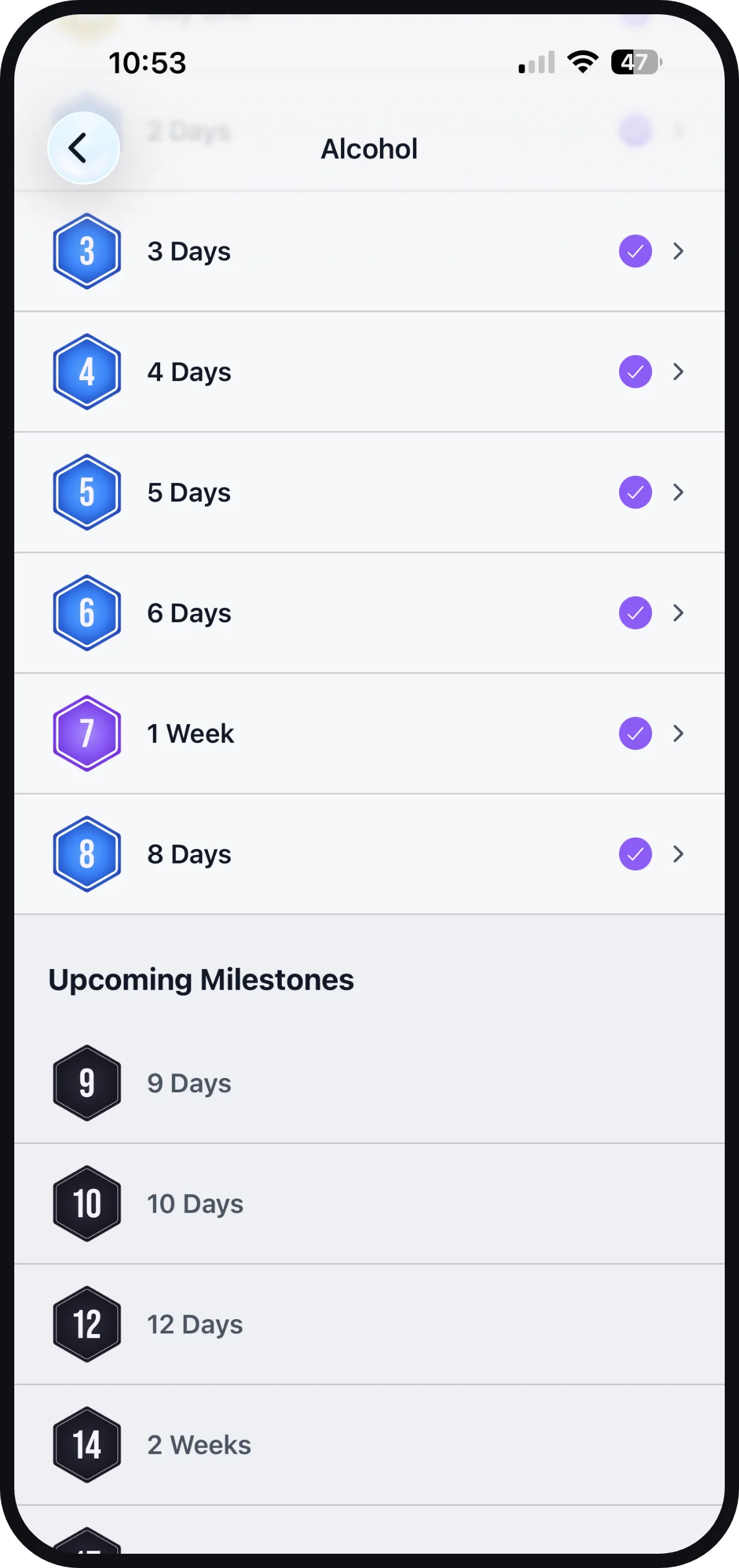
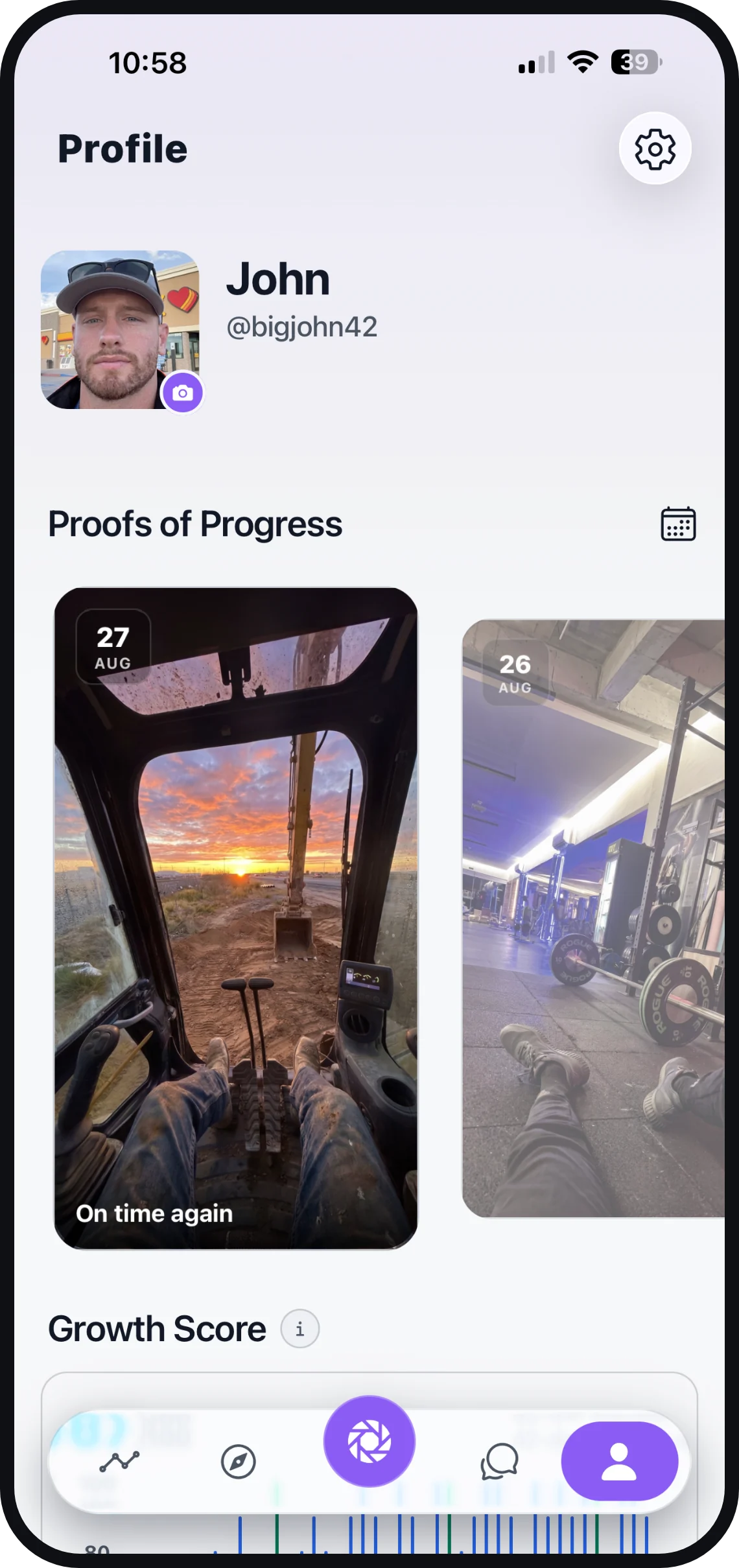
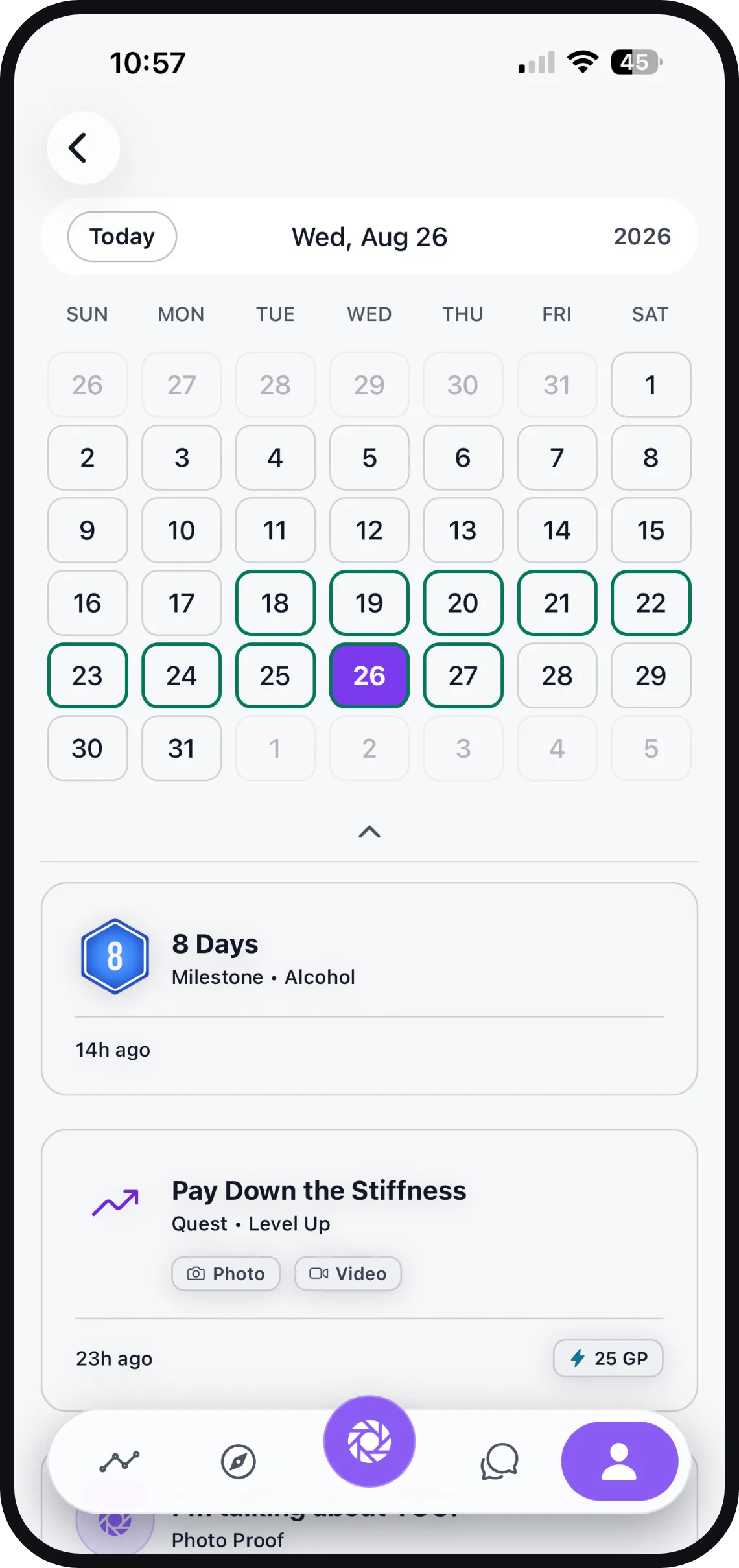
Door 24 was built around the retention problem, not around the counter. Every sober day becomes a Proof, a dated photo, video, voice note, or journal entry that lands on your timeline. The reason to open the app on day 40 is that the record itself is worth something by then. You can scroll back to week two and see the version of you that was barely holding on.
Your Growth Score is a 42-day rolling average of consistency, so a hard day bends the trend instead of deleting the work underneath it. The Freedom Ledger counts the money and time you have reclaimed. Sober Science explains what is happening in your body week by week, and the Daily Quest gives you one small action aimed at the person you are becoming. You can cover up to 10 vices, and nothing you record is visible to anyone else unless you decide otherwise.
Abstinence is not enough. Counters reset, people do not, and an app is only useful for as long as you are still opening it.
Related reading: why sobriety streaks backfire, how to measure sobriety progress beyond day counts, and why abstinence alone is not enough. For the money and time side, see the Freedom Ledger, or get the app.
Sources
- Kwan, I., Burchett, H. E. D., Macdowall, W., D'Souza, P., Stansfield, C., Kneale, D., & Sutcliffe, K. (2025). How effective are remote and/or digital interventions as part of alcohol and drug treatment and recovery support? A systematic review and meta-analysis. Addiction, 120(8), 1531-1550.
- Gustafson, D. H., McTavish, F. M., Chih, M.-Y., et al. (2014). A Smartphone Application to Support Recovery From Alcoholism: A Randomized Clinical Trial. JAMA Psychiatry, 71(5), 566-572.
- Baumel, A., Muench, F., Edan, S., & Kane, J. M. (2019). Objective User Engagement With Mental Health Apps: Systematic Search and Panel-Based Usage Analysis. Journal of Medical Internet Research, 21(9), e14567.
- Crane, D., Garnett, C., Brown, J., West, R., & Michie, S. (2015). Behavior Change Techniques in Popular Alcohol Reduction Apps: Content Analysis. Journal of Medical Internet Research, 17(5), e118.
- Substance Abuse and Mental Health Services Administration. 2025 National Survey on Drug Use and Health (NSDUH) Releases.
- National Institute on Drug Abuse. Treatment and Recovery.
- National Institute on Alcohol Abuse and Alcoholism. Alcohol Treatment Navigator.
Frequently asked
Do sobriety apps actually work?
The evidence is strongest when an app supplements other support. A 2025 systematic review in Addiction pooled 34 randomized trials with 6,461 participants and found 39 percent lower odds of relapse when remote or digital tools were added to in-person care. The authors flagged that more than 70 percent of the outcomes carried a high risk of bias, so the finding should be read as promising rather than settled.
Can a sobriety app replace treatment or a doctor?
No. An app is a support tool, not medical care. Alcohol withdrawal in particular can be medically dangerous, so anyone drinking heavily should speak to a doctor before stopping. The research on digital tools that fully replace in-person care is smaller and less certain than the research on tools that add to it.
Why do people stop using sobriety apps?
Because most health apps are abandoned quickly. A 2019 analysis of 93 widely installed mental health apps found a median 30-day retention of 3.3 percent. An app only helps for as long as you open it, so the design question that matters most is what gives you a reason to come back on day 40.
Are sobriety apps based on real science?
Many are not. A 2015 content analysis of 662 unique alcohol-related apps in the UK app store found that only 13.7 percent were aimed at reducing drinking. Among the 61 reduction apps coded in detail, the average was 3.6 behavior change techniques, just 16.4 percent mentioned any evidence base, and none referred to a behavioral theory. That sample is a decade old and UK-specific, but it is the reason to check what an app is actually built on.
What should I look for in a sobriety app?
Look for something that survives a bad day, records more than an absence, supports more than one habit, and keeps your data private by default. A measure that resets to zero after one slip is the most common reason people delete these apps at the exact moment they need them.