Getting sober
How do I start my sobriety journey?
To start your sobriety journey, do four things in order. Name exactly what you are quitting. Check whether stopping is medically safe for you, because roughly half of people who suddenly stop heavy drinking experience withdrawal. Pick a start date and write down why. Then capture proof of each sober day, so the person you are becoming has evidence, not just intentions.
Most people do not fail at sobriety because they lack willpower. They fail because they start with a feeling instead of a plan, and because nothing they do on day 4 leaves a mark they can look back on. Here is how to start in a way that holds.
How do I start my sobriety journey?
Start your sobriety journey with four moves, in this order: name it, make it safe, date it, and prove it.
Name it. Write down the exact substance or behavior and the honest amount. Alcohol, weed, nicotine, porn, scrolling. Vagueness protects the habit.
Make it safe. Stopping is not medically neutral for everyone. Clinicians writing in StatPearls (Canver, Newman and Gomez, updated February 14, 2024) note that approximately half of people who suddenly stop or reduce heavy drinking will experience alcohol withdrawal syndrome, and that 3 to 5 percent progress to alcohol withdrawal delirium, which can be fatal. Anyone who has had a complicated withdrawal before should not cut down without talking to their healthcare team first.
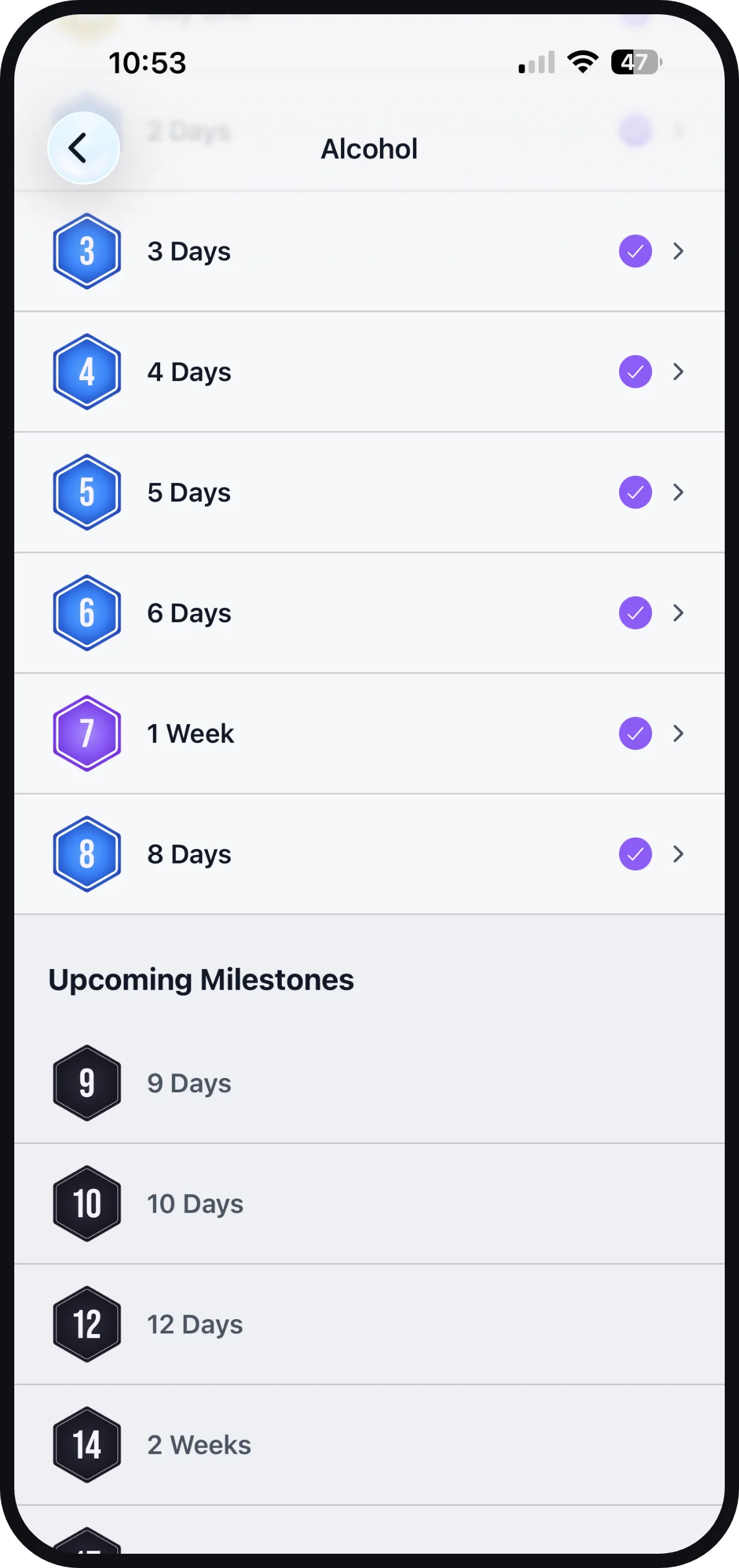
Date it. Choose a start date and write it down. That date becomes the anchor for everything you measure. See what a sobriety date is and why it matters.
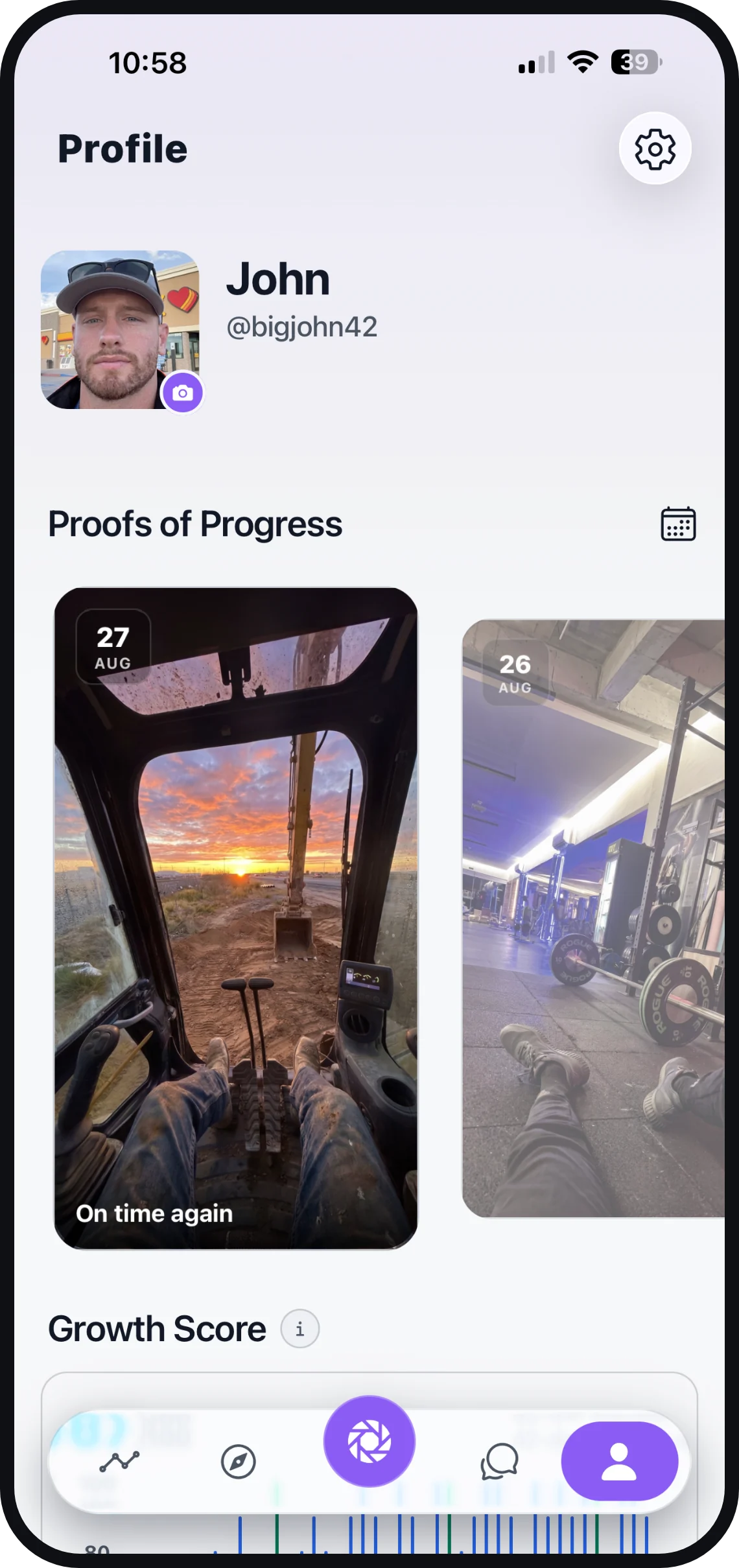
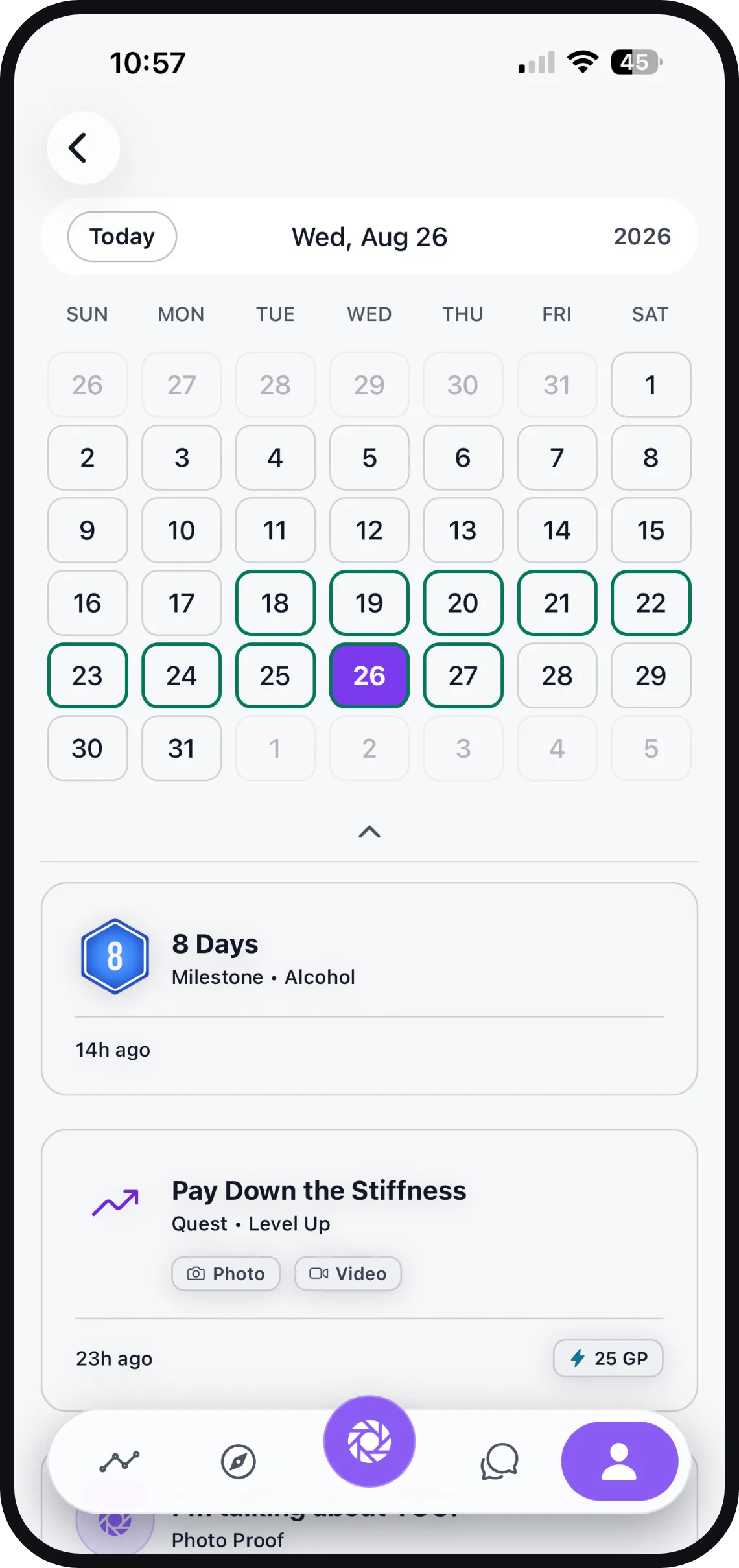
Prove it. From day one, capture a Proof: a photo, a video, a voice note, or a few sentences. It lands on a dated timeline. In six weeks you will be able to scroll back and see the person who was barely holding on, and compare.
Is it safe to quit drinking on my own?
Sometimes, and sometimes not. The deciding factor is how much you have been drinking and what happened the last time you stopped.
The clinical picture in the literature is specific. Alcohol withdrawal signs typically appear within hours of the last drink and peak around 72 hours. Withdrawal seizures usually occur between 8 and 48 hours after cessation. Alcohol withdrawal delirium, formerly called delirium tremens, can begin 3 to 8 days after the last drink and requires urgent care.
| Time since last drink | What the literature describes | What to do |
|---|---|---|
| 0 to 8 hours | Mild anxiety, headache, insomnia, stomach upset | Tell one person you are stopping |
| 8 to 48 hours | Window in which withdrawal seizures typically occur | Do not be alone. Seek care if symptoms escalate |
| ~72 hours | Signs and symptoms generally peak | Rest, fluids, food, monitoring |
| 3 to 8 days | Window for alcohol withdrawal delirium in a small minority | Emergency care immediately |
Source: Alcohol Withdrawal Syndrome, StatPearls, NCBI Bookshelf.
If you drink heavily every day, talk to a clinician before your start date. For a fuller walkthrough of the self-directed path, read how to stop drinking on your own.
Do I need treatment to start?
Not everyone does. But almost nobody who could benefit actually gets it, and that gap is the quiet reason a lot of first attempts stall.
According to NIAAA's alcohol treatment statistics, drawn from the 2024 National Survey on Drug Use and Health, 2.1 million people ages 12 and older with past-year alcohol use disorder received any alcohol use treatment, which is 7.6 percent of the 27.9 million people who had it. Three medications are FDA approved for alcohol use disorder: naltrexone, acamprosate, and disulfiram.
NIAAA Director George F. Koob, Ph.D., described the problem plainly when the agency launched its Alcohol Treatment Navigator in October 2017:
"We developed this tool to help address the alcohol 'treatment gap.' In any given year, less than 10 percent of individuals diagnosed with alcohol use disorder receive treatment, and many of them do not receive the type of care that best fits their needs."
Treatment is not an admission of weakness. It is a lever most people never pull.
What should I actually do on day one?
Do five concrete things. Not one of them takes an hour.
- Write your Freedom Pledge. One paragraph, your own words, addressed to yourself. Why now, and what you are refusing to keep paying for.
- Set your sobriety date and record it.
- Clear the house. Remove the thing you are quitting from the places you are weakest.
- Tell one person. Not a room. One.
- Capture your first Proof. A photo of your face today. You will want it later.
Then open your Freedom Ledger and let it start counting the money and the hours you are getting back. Redirect them on purpose, not by accident.
Why is abstinence not enough on its own?
Because abstinence describes what is missing, and you cannot build an identity out of an absence.
Not drinking is the entry fee. It is not the outcome. The version of you that does not need the habit has to actually exist, with evidence, or the old version comes back the first time the week goes badly. That is the Door 24 thesis: you do not quit a habit, you become someone who no longer needs it.
This is not wishful thinking about who you might be. It is the accumulated record of what you did. Every sober day becomes a Proof on a dated timeline. Sober Science explains what is happening in your body and mind week by week. A Daily Quest gives you one small action aimed at the person you are becoming, and a Side Quest gives you something to do when a craving arrives. Read more on rebuilding your identity in recovery.
Recovery is also more common than it looks from day one. In the National Recovery Study, Kelly and colleagues estimated that 22.35 million U.S. adults, about 9.1 percent, have resolved a significant problem with alcohol or other drugs. Most of them are not in a treatment center. They are in their kitchens.
What if I slip in the first 30 days?
You are not back at zero, because you were never a number.
This is where day counters do the most damage. A counter resets to 0 after a slip and hands you a clean, quantified reason to quit quitting. Your Growth Score does not work that way. It is a 42-day rolling average of consistency. A bad day bends the trend. It does not delete the Proofs you already stacked, and it does not delete the six weeks of evidence sitting on your timeline.
So treat a slip as data. Which trigger got through? What time was it? Who were you with? Write it down as a Proof, honestly, and keep going. Counters reset. People do not.
If you want a map of the next four weeks, read what the first 30 days of sobriety are like. When you are ready to start capturing proof, get Door 24.
Sources
- Alcohol Withdrawal Syndrome. Canver BR, Newman RK, Gomez AE. StatPearls, NCBI Bookshelf, updated February 14, 2024.
- Alcohol Treatment in the United States. National Institute on Alcohol Abuse and Alcoholism (2024 NSDUH data).
- NIAAA Alcohol Treatment Navigator points the way to quality treatment. NIH news release, October 3, 2017.
- Prevalence and Pathways of Recovery From Drug and Alcohol Problems in the United States Population. Kelly JF, Bergman B, Hoeppner BB, Vilsaint C, White WL. Drug and Alcohol Dependence, 2017.
Frequently asked
What is the first step in getting sober?
Name the specific thing you are quitting and how much of it you use, then pick a start date and decide what you will capture as proof on day one. Heavy daily drinking can produce withdrawal that needs medical supervision, so check that with a clinician before you stop.
How long does it take to feel better after you quit?
It varies. With alcohol, the acute withdrawal signs described in the medical literature usually peak around 72 hours after the last drink and settle over the following days. Sleep, mood, and energy tend to keep improving over weeks and months, not hours.
Do I need treatment to start my sobriety journey?
Not everyone does, but most people who could benefit never get it. In the 2024 National Survey on Drug Use and Health, only 7.6 percent of people with alcohol use disorder received any alcohol use treatment in the past year. Three medications for alcohol use disorder are FDA approved. Ask a clinician what fits you.
What if I slip in the first month?
A slip is information, not a verdict. It tells you which trigger got past your plan. Your Growth Score is a 42-day rolling average, so a bad day moves the trend without erasing the Proofs you already stacked.
Should I quit more than one thing at once?
That is your call, and many people are leaving more than one thing behind. Door 24 supports up to 10 vices in one place so you are not pretending the other ones do not exist.