Getting sober
What does sober curious mean, and how do I start?
Sober curious means questioning the role alcohol plays in your life without waiting for a crisis or a diagnosis. It is not a program, a pledge, or a label. It is a decision to pay attention. Most people who go sober curious remove alcohol for a set stretch of time, then watch what changes in their sleep, their mood, their money, and their sense of who they are.
Curiosity is not a weak place to begin. For a lot of people, it is the only honest one.
What does sober curious mean?
Sober curious means questioning the role alcohol plays in your life without waiting for a crisis, a rock bottom, or a diagnosis to give you permission. The term entered mainstream use through Ruby Warrington's 2018 book Sober Curious, and it describes a stance rather than a status. You are not claiming to be finished with alcohol. You are asking what your life looks like without it.
In practice, sober curious usually means one thing: you take alcohol out for a defined stretch of time and pay close attention. A weekend. Thirty days. A season. The point is not the abstaining. The point is what you notice when the noise stops.
That is also the limitation, and it is worth naming early. Curiosity asks a question. It does not answer it. At some point the person who feels better without alcohol has to decide whether to become someone who does not drink. That decision is a different kind of work. More on that below.
How many people are actually questioning their drinking?
More than at any point in nearly a century of measurement. Gallup found that 54 percent of U.S. adults said they consume alcohol in its annual Consumption Habits survey, conducted July 7 to 21, 2025 and published on August 13, 2025. That is the lowest reading in a trend Gallup has run since 1939, below the 55 percent recorded in 1958.
Gallup's Lydia Saad summarized the finding directly:
"The percentage of U.S. adults who say they consume alcohol has fallen to 54%, the lowest by one percentage point in Gallup's nearly 90-year trend."
Three other numbers from the same survey matter more than the headline:
- 53 percent of Americans now say drinking in moderation is bad for your health. That is the first majority Gallup has recorded, up from 28 percent in 2018.
- Among people who do drink, the average was 2.8 drinks in the previous seven days, the lowest figure since 1996 and down from 3.8 a year earlier.
- Among adults aged 18 to 34, the drinking rate fell to 50 percent, now below middle-aged and older adults.
Read those together and the picture is clear. The people questioning alcohol are not a fringe. They are the trend, and the youngest adults are leading it.
How do you know if it is more than curiosity?
You look at the pattern, not the feeling. The National Institute on Alcohol Abuse and Alcoholism defines drinking levels in plain, countable terms, built on a standard drink of 14 grams of pure alcohol, roughly 12 ounces of regular beer, 5 ounces of wine, or 1.5 ounces of distilled spirits.
| Pattern | Women | Men |
|---|---|---|
| Standard drink | 14 grams pure alcohol | 14 grams pure alcohol |
| Binge drinking (about 2 hours) | 4 or more drinks | 5 or more drinks |
| Heavy drinking | 4+ in a day or 8+ per week | 5+ in a day or 15+ per week |
| High-intensity drinking | 8 or more on an occasion | 10 or more on an occasion |
Source: NIAAA, Understanding Alcohol Drinking Patterns.
Alcohol use disorder is a separate thing: a medical condition defined by impaired ability to stop or control alcohol use despite consequences. NIAAA reports that 27.9 million people aged 12 and older, 9.7 percent of that age group, had AUD in the past year according to the 2024 National Survey on Drug Use and Health. The rate has fallen from 10.6 percent in 2021.
Two things follow. You do not need a diagnosis to stop. And if the numbers in that table describe your ordinary week, stopping without medical guidance can be unsafe. Withdrawal from heavy, sustained drinking is a physical event. Talk to a doctor first.
How do you start being sober curious?
Pick a window, write down why, and collect evidence while you are inside it.
- Set a defined stretch. Thirty days is popular for a reason. It is long enough for sleep and mood changes to surface, short enough to actually commit to. A weekend proves nothing. A year is a decision, not an experiment.
- Name your reason before day one. Write it in your own words. In Door 24 this is your Freedom Pledge, a written commitment you can look at on the days you have forgotten why you started.
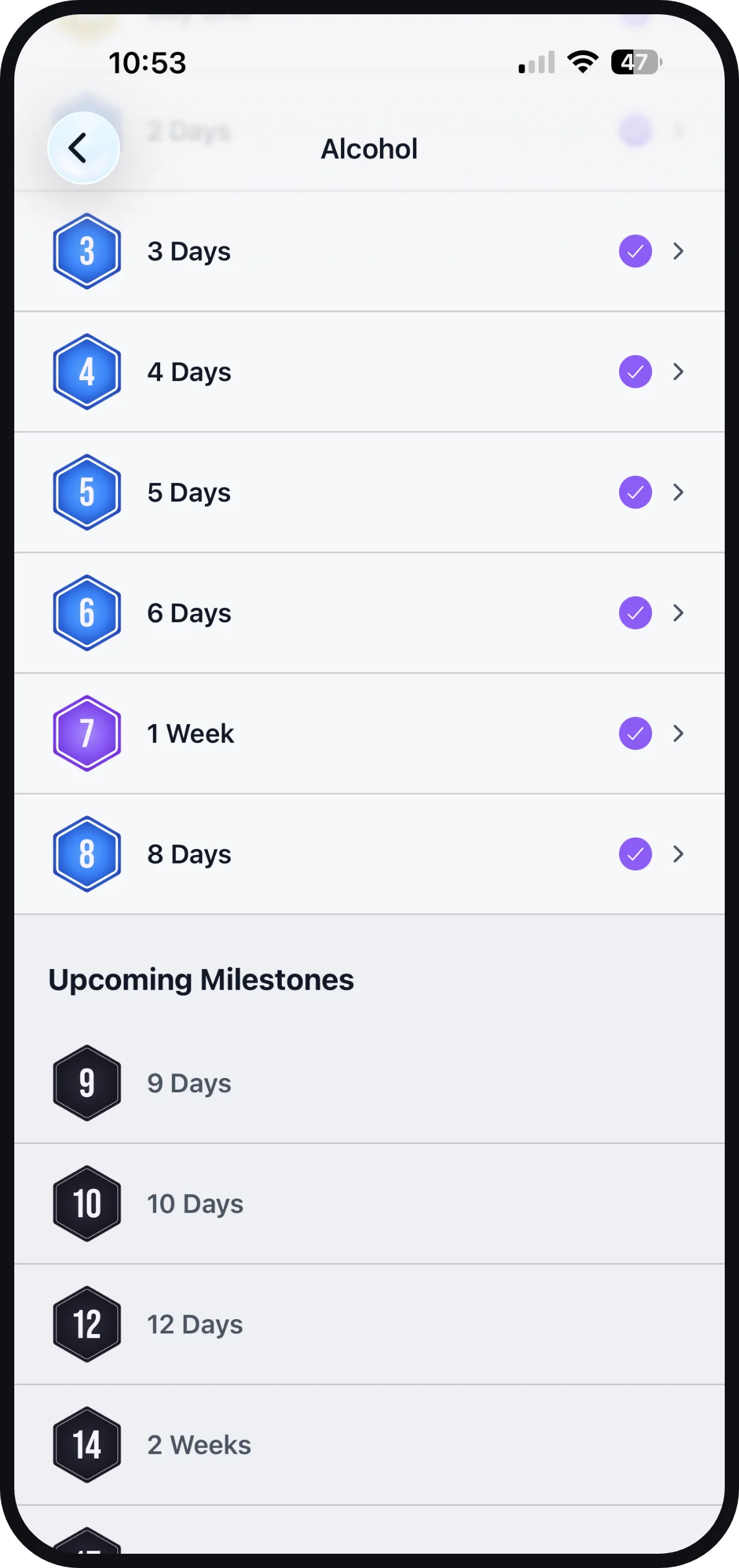
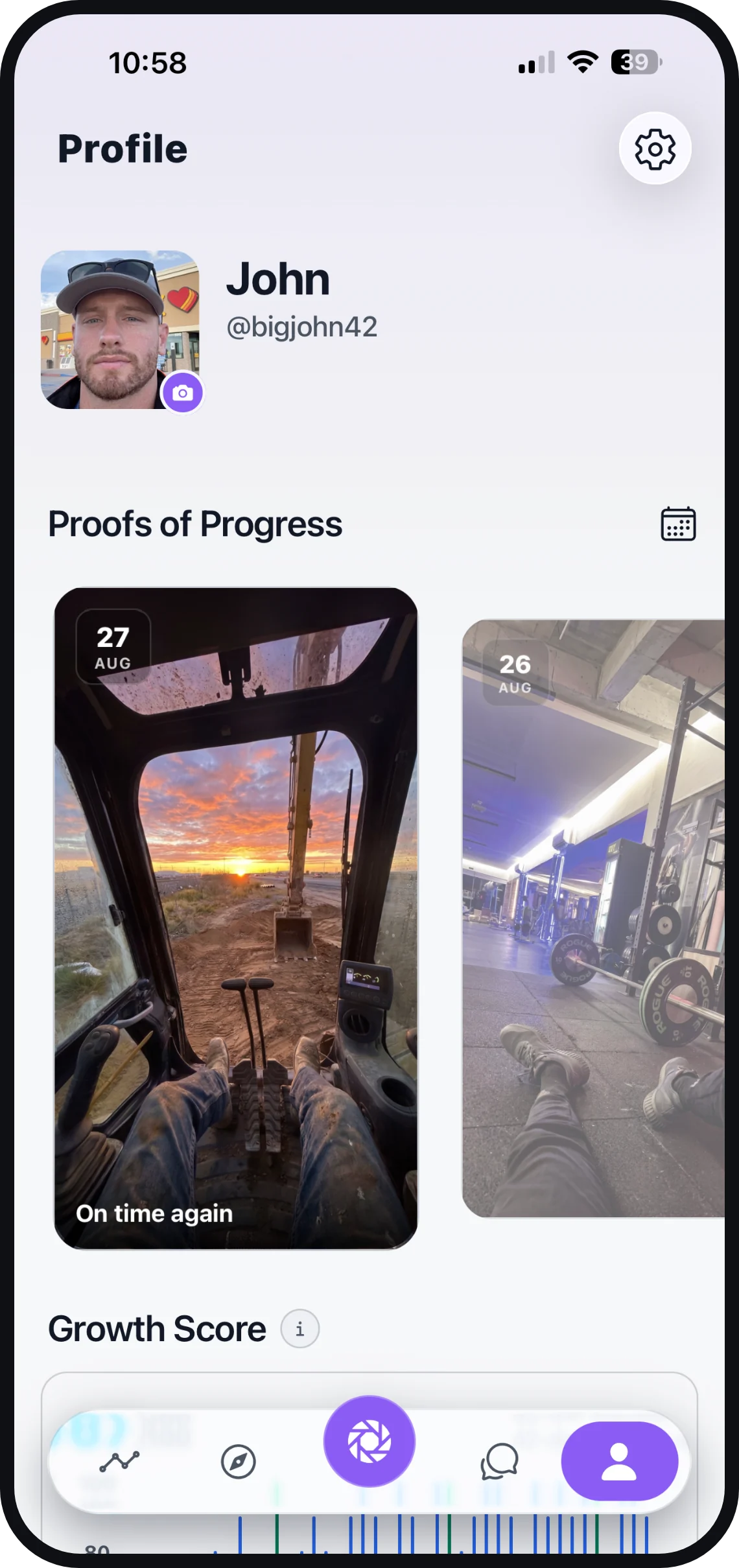
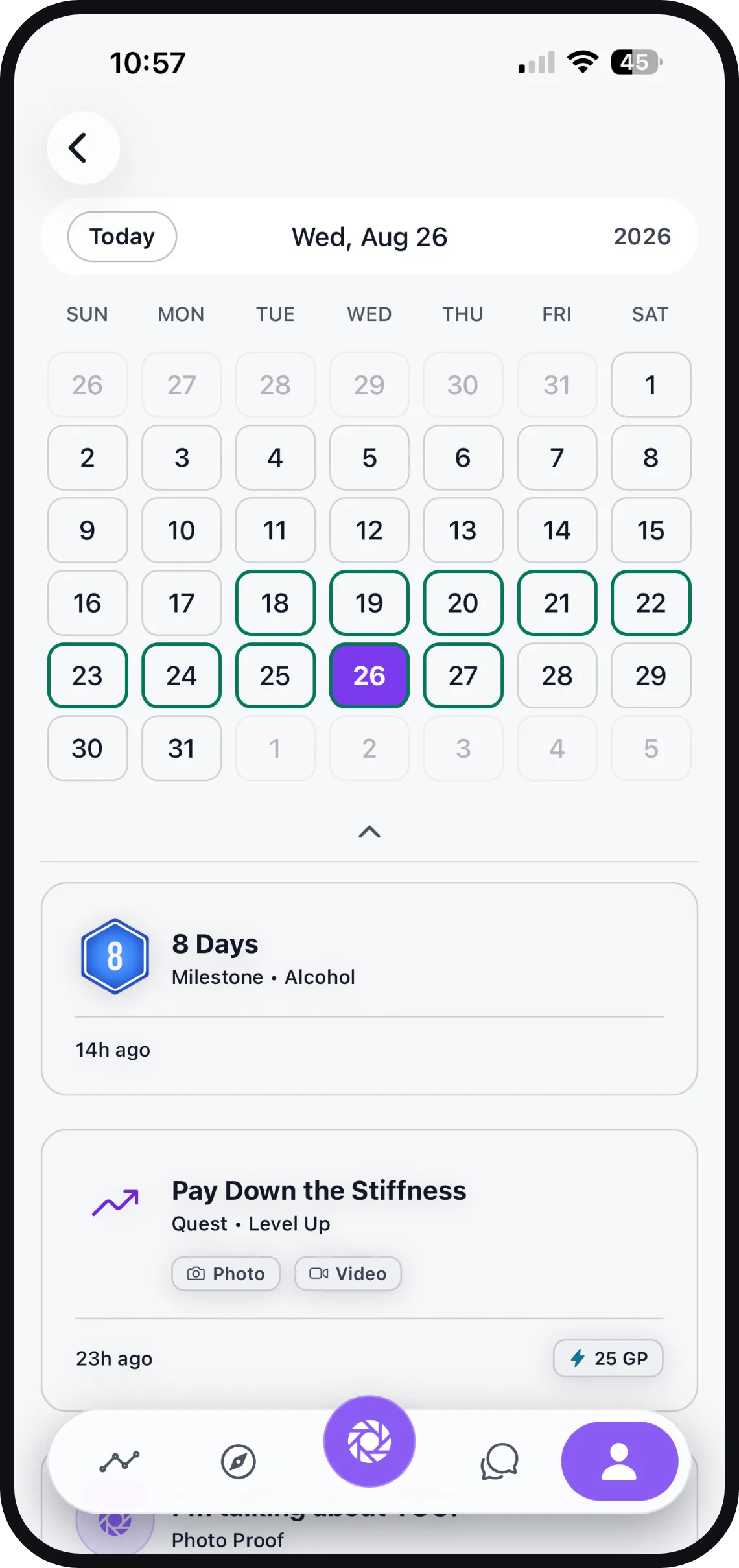
- Capture the days, do not just count them. A number tells you how long you have gone. It tells you nothing about what changed. Each day, take a Proof: a photo, a voice note, a video, or a few sentences. It lands on a dated timeline.
- Watch the trend, not the streak. Your Growth Score is a 42-day rolling average of consistency. A hard day shifts the trend. It does not delete the weeks behind it.
- Count what you got back. The Freedom Ledger tallies the money and the hours you have reclaimed. See what quitting is actually worth.
A month in, you will have something a counter cannot give you: a scrollable record of a person changing. Day 3 looks different from Day 27. The eyes are different. That is the whole argument.
What happens when curiosity is not enough?
Then you have your answer, and the work changes.
Here is the honest problem with sober curious as a permanent home. It keeps alcohol as the reference point. You are still organizing your life around a substance, just from the other side of the table. People relapse not because they lack willpower but because they are the same person, only without the drink. The gap never closed.
Abstinence is not enough. You do not quit a habit. You become someone who no longer needs it.
That is why Door 24 stacks Proof instead of counting days. Curiosity asks what would my life be like without this. Proof answers it, in your own face, on your own timeline, in a form you cannot argue with at 11pm on a bad Tuesday. Counters reset. People do not.
If you are somewhere in that transition, who am I without alcohol sits with the identity question directly. If the window has already closed and you know you are done, how to stop drinking on your own covers the practical first moves, and what the first 30 days of sobriety are like tells you what to expect. When you are ready to make the days count, open the door.
Sources
- Gallup, U.S. Drinking Rate at New Low as Alcohol Concerns Surge, Lydia Saad, August 13, 2025.
- NIAAA, Understanding Alcohol Drinking Patterns.
- NIAAA, Alcohol Use Disorder (AUD) in the United States, citing the 2024 National Survey on Drug Use and Health.
- SAMHSA, 2024 National Survey on Drug Use and Health.
Frequently asked
Is being sober curious the same as being sober?
No. Sober curious describes the questioning. Sober describes the practice. Curiosity is where a lot of people start, and it is a legitimate place to start. It becomes something else the day you decide you are done and begin building evidence of the person who no longer needs it.
How long should a sober curious break last?
Long enough to see past the first two weeks. Dry January and similar 30-day resets are popular because a month is long enough for sleep and mood shifts to show up, and short enough to commit to. If a month feels impossible to imagine, that is information worth sitting with.
Do I need a diagnosis to stop drinking?
No. Alcohol use disorder is a clinical diagnosis, and 27.9 million Americans aged 12 and older met the criteria in 2024 according to NSDUH data. Millions more never will and still want out. You do not need a label to change. You need a reason and a way to see the change happening.
What if I try a sober curious break and it goes badly?
That is data, not a verdict. If you cannot get through a planned break, or you feel physically unwell when you stop, talk to a doctor. Withdrawal from heavy drinking can be dangerous.